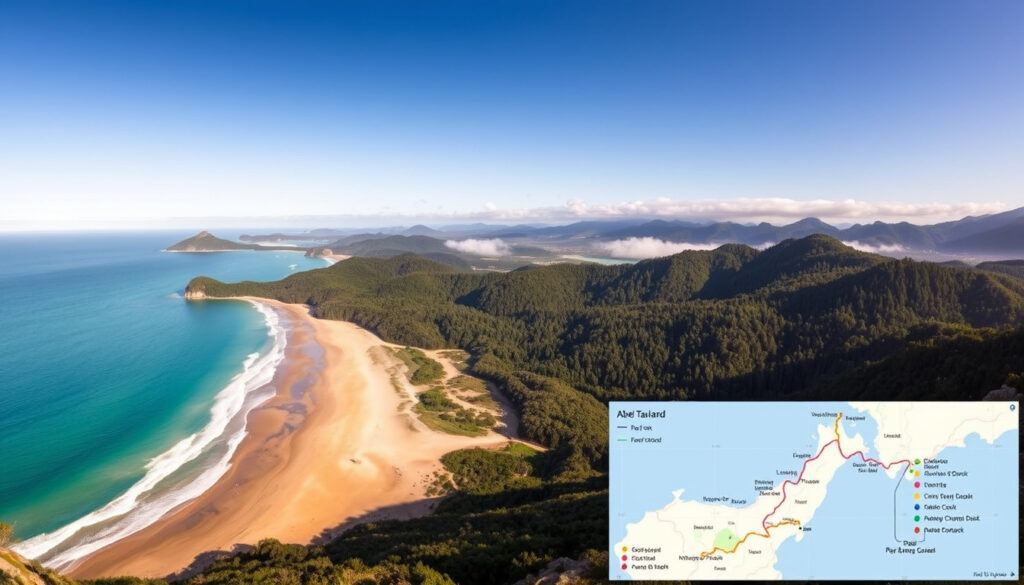
Abel Tasman Track Map: Full Guide with Costs & Tide Info
There’s a reason the Abel Tasman Coast Track is one of New Zealand’s most popular Great Walks — it’s a stunning mix of golden beaches, lush forest, and turquoise water that feels more like a tropical island than a tramping track. But planning a walk here isn’t as simple as just showing up; you need the right map, tide windows, and accommodation plan — this guide brings together the official DOC track map, water taxi logistics, hut fees, and facility details so you can build a day-by-day itinerary that actually works.
Total length: 60 km (one way) · Typical duration: 3 to 5 days · Managed by: Department of Conservation (DOC) · Tide-dependent sections: Yes, at Awaroa Inlet · Huts/campsites with toilets: All major huts and campsites · Water taxi access points: Marahau, Kaiteriteri, Totaranui, Wainui
Quick snapshot
- Full track distance is 60 km one way (DOC track guide)
- 4 huts and 19 campsites along the coast (Abel Tasman FAQ)
- All DOC huts have toilets and tap water (100% Pure New Zealand)
- Awaroa Inlet must be crossed within 1.5 hours before to 2 hours after low tide (DOC tide safety)
- Exact daily walking times vary by fitness, pack weight, and tide conditions (New Zealand Spirit)
- Water taxi prices are subject to seasonal change; check with operators for current rates (Abel Tasman blog) (New Zealand Spirit)
- Best campsites depend on whether you prefer seclusion or proximity to facilities (The Wanderlogs)
- Typical duration: 3–5 days for the full coast track (DOC track guide)
- Great Walk season runs October to April; huts must be booked in advance year-round (Abel Tasman FAQ)
- Water taxis operate daily but on reduced schedules in winter (New Zealand Spirit)
- Download the official DOC PDF map with hut locations, campsites, and tide information (DOC PDF)
- Book huts or campsites via the DOC website before you arrive (Abel Tasman FAQ)
- Arrange water taxi transfers from Marahau, Kaiteriteri, Totaranui, or Wainui (100% Pure New Zealand)
Eight key facts, one pattern: the track is well mapped but demands careful planning around tides, bookings, and transport. The official DOC guide and commercial operators provide overlapping but distinct information.
| Detail | Value |
|---|---|
| Track length | 60 km (one way) |
| Time to walk | 3–5 days |
| Great Walk season | October to April (hut booking required) |
| Total huts | 4 huts (Anchorage, Bark Bay, Awaroa, Whariwharangi) |
| Total campsites | 22 campsites (some need tide access) |
| Highest point | ~180 m above sea level |
| Water taxi drop-off options | Marahau, Kaiteriteri, Totaranui, Wainui, and others |
| Tide crossing required | Awaroa Inlet (check tide tables) |
How long does it take to walk the Abel Tasman track?
Typical duration for the full Coast Track
- The full Abel Tasman Coast Track is 60 km one way, taking most walkers 3 to 5 days (DOC track guide).
- Faster hikers can complete it in 2 days, but that leaves little time to enjoy the beaches and side tracks (New Zealand Spirit).
- The official DOC advice recommends a minimum of 3 days for a comfortable pace (100% Pure New Zealand).
Half-day and day-walk options
- Day walks from Marahau to Anchorage (12.4 km one way, 4–5 hours) are popular (Abel Tasman blog).
- Kaiteriteri to Marahau or Tinline Bay offers shorter alternatives (100% Pure New Zealand).
- The tide at Awaroa Inlet can affect timing if you plan to cross it on a day walk (DOC tide safety).
The 3–5 day itinerary gives you enough time to catch the tide windows and enjoy the scenery. Day walkers save money on huts but miss the northern section unless they use a water taxi.
The pattern: the track’s length is modest, but the tide constraints and hut spacing dictate the pace more than fitness does.
How much does it cost to walk the Abel Tasman track?
Hut and campsite fees
- During the Great Walk season (October to April), hut fees are NZ$32–$44 per adult per night (Abel Tasman FAQ).
- Campsite fees range from NZ$14 to $20 per adult per night (Abel Tasman FAQ).
- In winter (May to September), hut fees drop to NZ$15 per night under backcountry pricing (New Zealand Spirit).
Water taxi costs
- Water taxi fares typically range from NZ$35 to $55 per person per leg (Abel Tasman blog).
- Services run between Marahau/Kaiteriteri and Totaranui, with scheduled pickups at Anchorage, Bark Bay, Awaroa, and other points (100% Pure New Zealand).
- Some operators offer return trips or multi-drop packages; prices vary by distance and season (New Zealand Spirit).
DOC Great Walk season pricing
- Backcountry hut passes are not valid during the Great Walk season (October–April) (DOC track guide).
- All bookings must be made through the DOC website; walk-in requests are not accepted (Abel Tasman FAQ).
A 3-day solo trip during Great Walk season (2 nights in huts) costs around NZ$64–$88 for accommodation, plus at least one water taxi leg ($35–$55). That’s NZ$100–$143 before food and transport to the trailhead. Budget accordingly.
The trade-off: walking in winter halves your accommodation costs, but water taxis run less frequently and you’ll need more gear for wetter conditions.
Are there toilets and drinking water on the Abel Tasman track?
Toilet locations along the track
- All four DOC huts (Anchorage, Bark Bay, Awaroa, Whariwharangi) have flush toilets (DOC track guide).
- Most major campsites (e.g., Anchorage, Bark Bay, Awaroa, Totaranui) also have toilets (100% Pure New Zealand).
- Some remote campsites (like Separation Point or Tinline Bay) have no toilet facilities; pack out your waste (Abel Tasman blog).
Drinking water sources and treatment advice
- DOC huts provide treated tap water at the kitchen sink (DOC track guide).
- Stream water is available along the track but must be boiled or treated before drinking (New Zealand Spirit).
- There are no drinking water taps at campsites; plan to carry water from huts or treat natural sources (Abel Tasman FAQ).
The pattern: huts provide reliable facilities, but if you’re camping at a non-hut site, you carry your water and manage your waste. The trade-off is comfort vs. isolation.
Can you do an Abel Tasman walk for a day?
Popular day walks: Marahau to Anchorage
- The most popular day walk is Marahau to Anchorage, 12.4 km one way, taking 4–5 hours (Abel Tasman blog).
- From Anchorage, you can return via the same route or catch a water taxi back to Marahau (100% Pure New Zealand).
- The track is well graded and suitable for reasonably fit walkers, including older children (New Zealand Spirit).
Using water taxis to shorten walks
- Water taxis drop you at any of the scheduled stops (e.g., Medlands, Bark Bay, Awaroa) so you can walk a one-way section and get picked up later (100% Pure New Zealand).
- This allows custom day walks: for example, get dropped at Bark Bay and walk back to Marahau (about 14 km, 5–6 hours) (Abel Tasman blog).
- Note that water taxis do not go north of Totaranui, so day walks from the northern end are limited (DOC track guide).
If you plan a day walk involving the Awaroa Inlet crossing, you must check the tide tables. Missing the window could leave you stranded for hours.
The implication: day walks are practical and rewarding, but the best sections require a water taxi, which adds cost and schedule dependency.
Where can I find an Abel Tasman track map with water taxi stops and campsites?
Official DOC PDF map
- The DOC track guide PDF includes hut locations, campsites, water taxi pickup points, and tide information for Awaroa Inlet (DOC track guide).
- It also shows the Inland Track option and indicates where high-tide routes exist (Torrent Bay, Bark Bay) (DOC track guide).
Water taxi map by Abel Tasman Guides
- Abel Tasman Guides (abeltasman.com) provides a map overlay showing water taxi timetables, prices, and scheduled stops (Abel Tasman blog).
- Their FAQ page lists all pickup locations and booking procedures (Abel Tasman FAQ).
Interactive map on AllTrails
- AllTrails offers a GPS-enabled map of the full track with user reviews, photos, and elevation profiles (The Wanderlogs).
- Note that AllTrails is a community-sourced platform; trail conditions may not reflect recent DOC updates (The Wanderlogs).
The trade-off: the DOC map is authoritative and free, but it doesn’t include live water taxi schedules. Combine the DOC PDF with the commercial operator’s timetable for complete planning.
Upsides
- Well-maintained track suitable for all fitness levels
- Stunning coastal scenery with golden beaches and native bush
- Multiple day-walk options using water taxis
- Reliable facilities at huts (toilets, tap water, cooking shelters)
- Water taxis provide flexibility for custom itineraries
Downsides
- Huts and campsites must be booked year-round – no spontaneous walk-ins
- Tide constraints at Awaroa Inlet and Bark Bay estuary can break your schedule
- Hut and water taxi costs add up quickly (NZ$100+ per day for solo walkers)
- Some remote campsites lack toilets and drinking water
- Water taxis don’t run north of Totaranui, limiting access to the northern section
How to plan your Abel Tasman walk using the track map
- Download the official DOC PDF map – it contains all hut and campsite locations, tide windows, and water taxi stops. Print it or save it offline (DOC track guide).
- Check the tide tables for Awaroa Inlet. The crossing is only possible 1.5 hours before to 2 hours after low tide (DOC tide safety). Bark Bay estuary also has a 2-hour window on either side of low tide (New Zealand Spirit).
- Book huts or campsites through the DOC website. During Great Walk season (Oct–Apr), backcountry passes are not valid (Abel Tasman FAQ).
- Arrange water taxi transfers from Marahau, Kaiteriteri, Totaranui, or Wainui. Confirm pickup times and prices with the operator in advance (100% Pure New Zealand).
- Pack essential gear: a tide timetable, enough water for stretches between huts, food for the duration, and a first-aid kit. Stream water requires treatment (New Zealand Spirit).
Confirmed facts and what remains unclear
Confirmed facts
- Track distance is 60 km one way (DOC track guide)
- All DOC huts have toilets and tap water (100% Pure New Zealand)
- Water taxi services operate year-round, with reduced winter schedules (New Zealand Spirit)
- Awaroa Inlet must be crossed at low tide (1.5h before to 2h after) (DOC tide safety)
What’s unclear
- Exact daily walking times vary by fitness and tide conditions (New Zealand Spirit)
- Water taxi prices are subject to seasonal change; always check with the operator (Abel Tasman blog)
- Best campsites depend on personal preference for seclusion vs facilities (The Wanderlogs)
“Awaroa Inlet should be crossed within 1 hour 30 minutes before and 2 hours after low tide.”
Department of Conservation (official DOC track guide)
“Commercial water taxis operate between Mārahau/Kaiteriteri and Totaranui, with scheduled pickup locations including Apple Tree Bay, Anchorage, Medlands Bay, Bark Bay, Tonga Quarry, Onetahuti, Awaroa, and Totaranui.”
100% Pure New Zealand (official tourism site)
For anyone planning an Abel Tasman walk, the choice is straightforward: invest the time to understand the tide tables and map before you arrive, or risk being stuck on the wrong side of Awaroa Inlet with a missed water taxi booking. The DOC map combined with a water taxi operator’s timetable gives you everything you need to build a solid itinerary.
Related reading: Abel Tasman Coast Track map, water taxi costs, hut booking, tide crossing guide · Abel Tasman Coast Track information and tide crossing guide
en.wikipedia.org, facebook.com, walkmyworld.com, ontheslowdown.com
Frequently asked questions
Do I need to book huts and campsites in advance?
Yes – all huts and campsites on the Abel Tasman Coast Track must be booked in advance year-round through the DOC website. Walk-in bookings are not accepted (Abel Tasman FAQ).
Can I walk the Abel Tasman track without a reservation?
No – you must have a valid booking for each night of your trip. If you don’t have a reservation, you cannot stay in huts or campsites. Day walks do not require a booking (Abel Tasman FAQ).
What is the best time of year to walk the Abel Tasman Coast Track?
The best time is during the Great Walk season (October to April) when the weather is warmer and water taxis run full schedules. However, it’s also the busiest period. Winter (May–September) offers lower hut fees but fewer water taxi services and wetter conditions (New Zealand Spirit).
Are dogs allowed on the Abel Tasman track?
No – dogs are not permitted on the Abel Tasman Coast Track or anywhere in Abel Tasman National Park due to the risk to native wildlife (DOC track guide).
Is the Abel Tasman track suitable for children?
Yes, the track is well graded and suitable for older children (aged 8+) who are used to walking. Day walks from Marahau to Anchorage are particularly family-friendly. Multi-day trips require careful planning around tide crossings and pack weight (New Zealand Spirit).
What should I pack for the Abel Tasman Coast Track?
Pack a tide timetable, water bottle (or treatment method), warm layers, rain jacket, sun protection, insect repellent, first-aid kit, and food for the duration. Hut kitchens have cooking facilities but no utensils (Abel Tasman blog).
Are there guided walks available on the Abel Tasman track?
Yes – several tour operators offer guided walks, including multi-day trips with accommodation and meals. These are typically more expensive than self-guided trips but remove the logistics burden (Abel Tasman blog).
How do I get to the trailhead from Nelson or Motueka?
Shuttle buses run from Nelson (about 1.5 hours) and Motueka (45 minutes) to Marahau and Kaiteriteri. Water taxi operators also provide shuttle services. Private vehicles can park at the Marahau car park (100% Pure New Zealand).
Related reading
- Abel Tasman Coast Track map, water taxi costs, hut booking, tide crossing guide – official FAQ from Abel Tasman
- Abel Tasman Coast Track information and tide crossing guide – detailed blog with practical tips
More related posts
 Pak n Save Henderson: Hours, Online Shopping, Specials & Locations
 How Long Does Temu Take to Ship to NZ? 2025 Delivery Times
 Ranfurly Shield Game Today: Current Holder, Score & How to Watch
 Book a Bach Rarotonga: Complete Holiday Home Guide
 Turtle Beach Stealth 600: Review, PS5 Setup, Comparisons
 10 Stone in kg Conversion – Accurate & BMI Context
 NZ Take Home Pay Calculator 2026 – Step-by-Step Guide
 Cast of Beyond Paradise: Guest Stars, Departures, Locations