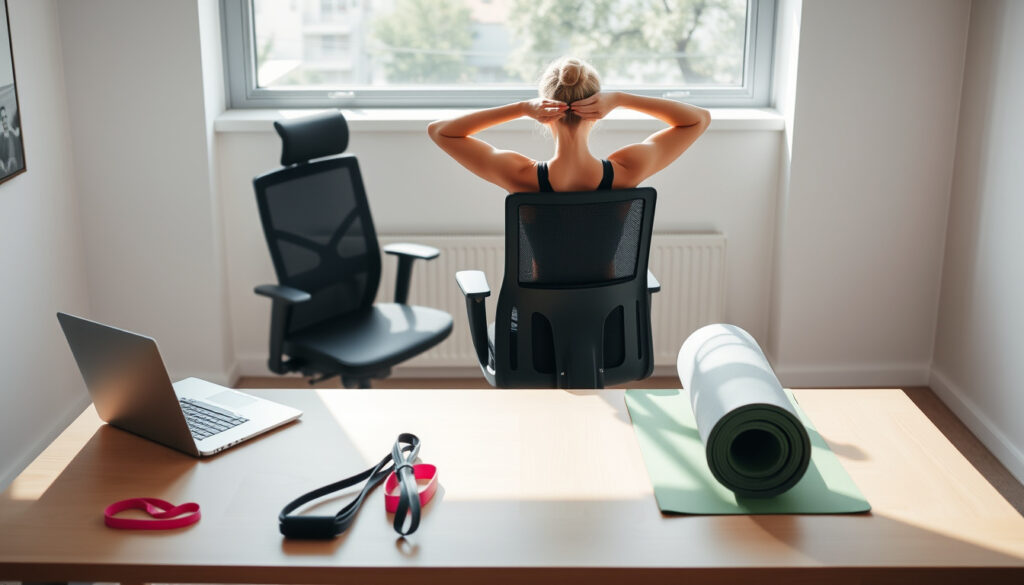
Best Exercises for Desk Workers: Clinic-Backed Stretches & Routines
If your neck feels like it’s aging faster than the rest of you, you’re not alone. Eight hours hunched over a keyboard takes a toll on shoulders, hips, and spine — but a 2023 Cornell University study found that 30-second movement breaks every 20 minutes can prevent tissue damage from sitting, and physical therapists consistently affirm that frequency beats duration when it comes to desk stretches.
Exercises Listed in Top Guides: 6-15 per routine ·
Common Focus Areas: Neck, shoulders, hips ·
Routine Lengths: 5-10 minutes ·
Sources Analyzed: Healthline, Cleveland Clinic ·
Stretch Types: Hand, neck, calf raises
Quick snapshot
- Stretches reduce aches per multiple sources (Healthline)
- 5-10 min routines target neck, back, hips (Daily Burn)
- Healthline medically reviewed by DPT Gregory Minnis (Healthline)
- Exact muscle growth rates at desks
- Long-term posture correction timelines
- Cornell study published 2023 on movement breaks
- Healthline article updated April 2026
- Micro-break culture gaining traction in workplaces
- More employers adopting hourly stretch reminders
This comparison table shows the core attributes that top clinic sources align on for desk worker exercise programs.
| Attribute | Value |
|---|---|
| Top Exercises Count | 12 from Healthline |
| Routine Duration | 5-10 minutes |
| Pain Areas Targeted | Neck, back, hips |
| Source Types | Clinics and health sites |
What exercises can I do while working at a desk?
More than you think. The key is choosing moves that target the areas most strained by prolonged sitting — chest, hips, neck, thoracic spine, and lumbar spine. Mayo Clinic (a Tier 1 medical institution) provides an official video collection of desk stretches designed specifically to prevent stiffness from prolonged sitting. These are discreet enough to do during a Zoom call or while waiting for a file to load.
Hand and finger stretches
- Make a fist, then spread fingers wide — repeat 5 times to circulation boost
- Rotate wrists in circles, both directions, for 10 seconds
Neck rotations
- Slowly roll head in a circle, pausing at each corner
- Tilt ear to shoulder, hold 10-15 seconds per side (per Healthline’s medically reviewed guide)
Leg extensions
- Seated leg extensions straighten knees against invisible resistance
- Toe raises under desk activate calf pumps for circulation
Desk stretches to try at work to ease your aches and pains
If you’ve ever felt a knot form between your shoulder blades by 2 p.m., desk stretches aren’t optional — they’re corrective. The American Physical Therapy Association recommends the Seated Chest Opener specifically for computer users who develop forward-shoulder posture. Daily Burn notes that desk stretches target five primary pain zones: chest, hips, neck, thoracic spine, and lumbar spine. Here are the moves physical therapists and health publications actually recommend.
Shoulder squeezes
- Sit tall, draw shoulder blades together as if holding a pencil between them
- Hold 5 seconds per CCOHS government ergonomics guidelines
Pectorals stretch
- Clasp hands behind back, push chest outward, hold 10-30 seconds per Healthline
- Opens pectoralis minor — the muscle shortened by keyboard hunching
Chin tucks
- Draw chin straight back, creating a “double chin” hold
- Targets upper cervical spine strained by screen gaze
For every inch your head drifts forward, the effective load on your neck muscles jumps by 10 pounds. A head weighing 10-12 pounds becomes the equivalent of 20-plus pounds of strain on your cervical spine — making even small posture shifts consequential for desk workers.
Which exercise is best for office workers?
There’s no single best exercise — there’s a best sequence. Physical therapists and health publications consistently highlight hip flexor stretches, calf raises, and abdominal activation as the trio that addresses the root causes of sitting-related pain. Dr. Ingrid Yang (a hospitalist and wellness expert) recommends side stretches specifically for desk workers, noting that the thoracic spine rotation is often the first movement lost among people who sit for long hours.
Hip flexions
- Seated Figure-Four: cross ankle over opposite knee, lean forward gently
- Targets piriformis and hip flexors — muscles that shorten from sitting
Calf raises
- Rise onto toes while seated or standing beside desk
- Activates the “calf pump” to push blood back toward the heart
Abdominal stretches
- Seated Cat-Cow: alternate arching and rounding spine while seated
- Mobilizes every spinal segment per Daily Burn’s research-backed guide
Hip flexions, calf raises, and abdominal stretches form the foundation of desk routines because they directly counter what prolonged sitting does to the body — shortened hip flexors, sluggish circulation, and a flattened lumbar curve — giving office workers a practical toolkit against cumulative strain.
How to build muscle at a desk job?
Building muscle while seated sounds counterintuitive, but it’s absolutely possible with isometric holds and resistance-based moves. Bryan Health notes that the sneakiest exercises for desk workers involve using your own body weight as resistance — no equipment required, and no one needs to know you’re doing bicep curls under your desk. The key is consistency over intensity: daily brief contractions outperform occasional gym sessions for maintaining muscle tone.
Sneaky strength moves
- Isometric tricep extensions: press palms together at chest height, hold 30 seconds
- Seated leg lifts: raise knees against the chair’s resistance
Seated muscle builders
- Seated March: lift knees alternately while maintaining posture
- Builds hip flexor endurance without leaving your chair
Desk-based resistance
- Desk push-ups: lean against desk edge, lower chest toward keyboard, push back
- Activates chest and triceps in under 60 seconds
What is the 3-3-3 rule for exercise?
The 3-3-3 framework offers a simple weekly structure: three types of exercise (strength, cardio, flexibility), done three times per week, in 30-minute sessions. For desk workers specifically, Snap Fitness and beginner fitness guides adapt this to office life by spreading those three types across the workday — a morning walk for cardio, desk stretches for flexibility, and seated resistance work for strength.
Three types of exercise
- Strength: builds muscle and protects joints
- Cardio: boosts heart health and circulation
- Flexibility: prevents the stiffness that compounds from sitting
Weekly framework
- 3 sessions per week minimum for health benefits
- Spread across weekdays — desk workers can use lunch breaks strategically
Application for desk workers
- Micro-breaks every 30-60 minutes satisfy the flexibility component
- A 10-minute walk at lunch covers cardio
- Seated isometric holds address strength
The 3-3-3 rule isn’t about maximizing workout intensity — it’s about creating a sustainable scaffold that desk workers can actually maintain. Three short bouts of different exercise types across the day accumulate more health benefit than one neglected gym visit per week.
Upsides
- Stretches reduce aches and improve posture per multiple clinic sources
- 5-10 minute routines fit any schedule without leaving the desk
- Micro-breaks every 30-60 minutes prevent tissue deformation (Cornell 2023)
- Healthline medically reviewed by Gregory Minnis, DPT (Tier 1 quality signal)
Downsides
- Exact muscle growth rates at desks remain scientifically unclear
- Long-term posture correction timelines vary by individual
- Discreet stretches have limited range of motion benefits
- Desk exercises cannot fully replace weight-bearing resistance training
Micro-breaks — brief, frequent movement interruptions throughout the workday — are more effective than a single long stretching session at reducing pain and improving posture.
— Daily Burn (Fitness Publication)
Do you sit at a desk all day? To prevent or ease stiffness and pain, try some simple workplace stretches.
— Mayo Clinic (Medical Institution)
Stretching leads to fewer injuries, improved posture, and helps you relax.
— Healthline via LIVE FOR LIFE (Health Website)
For office workers, the writing is on the wall: sustained sitting without movement breaks doesn’t just cause discomfort — it actively deforms spine tissue and accumulates load on neck muscles. A 2023 Cornell University study proved that 30-second movement breaks every 20 minutes prevent the tissue damage that leads to chronic pain. The solution isn’t a gym membership or a dramatic lifestyle overhaul — it’s building brief, targeted desk exercises into the rhythm of your workday.
Related reading: KJ to Calories Calculator · Rice Water for Hair Benefits
qural.app, inclinehealth.com.au, healthline.com, youtube.com, sharphealthplan.com, youtube.com, youtube.com
Prolonged sitting often triggers lower back pain in desk workers, which the McGill Big 3 protocol effectively addresses through targeted stability movements.
Frequently asked questions
What is the best desk exercise equipment?
Resistance bands, under-desk pedal machines, and balance boards are the most practical additions. However, the most effective equipment is arguably your own body weight — no cost, no clutter, and available everywhere.
Are there exercises at your desk to lose weight?
Desk exercises burn limited calories alone, but they prevent metabolic slowdown from inactivity. Seated leg lifts, isometric holds, and desk push-ups contribute to daily calorie expenditure when combined with regular movement breaks.
What are 5 minute stretches for office workers?
Per Incline Health’s routine: Shoulder Blade Squeeze (5 reps), Chin Tucks (5 reps), Levator Scapula Stretch (5 each side), Seated Spinal Twist (5 each side), and Wrist Stretch — each held for 5 seconds. Total time: approximately 5 minutes.
How often should desk workers exercise?
Physical therapists recommend micro-breaks every 30-60 minutes for 2-3 stretches, or a full 5-minute routine once per hour. A 2023 Cornell study found that 30-second movement breaks every 20 minutes prevent spine tissue deformation.
Do desk exercises improve posture?
Yes. Consistent desk stretching counteracts the forward-shoulder and head posture caused by keyboard work. The Seated Chest Opener specifically targets pectoralis minor shortening, while chin tucks address upper cervical strain.
What are ergonomic exercises for office workers?
Ergonomic exercises target the muscles most affected by poor workstation setup: upper trapezius, levator scapulae, pectoralis minor, hip flexors, and lumbar stabilizers. Healthline and CCOHS provide medically reviewed routines covering all five areas.
Can desk workouts replace gym time?
Desk workouts maintain muscle endurance and combat sedentary effects, but they cannot fully replace weight-bearing resistance training for bone density and major strength gains. Think of desk exercises as essential maintenance, not a substitute for the gym.
More related posts
 How Long to Hard Boil an Egg – Perfect Times by Size and Method
 West Auckland Power Outage: Check Causes & Safety Tips
 New Zealand Latest News – Today’s Breaking Stories and Updates
 Happy New Year Wishes: Best Messages, Quotes & Sayings for 2026
 Earthquakes Today NZ Just Now – Live GeoNet Map
 Night and Day Invercargill: Hours, Menu, Delivery Guide
 Round the Bays Auckland 2025: Date, Results & Highlights
 Arsenal F.C. vs PSV Eindhoven Lineups: 7-1 Win Match Recap