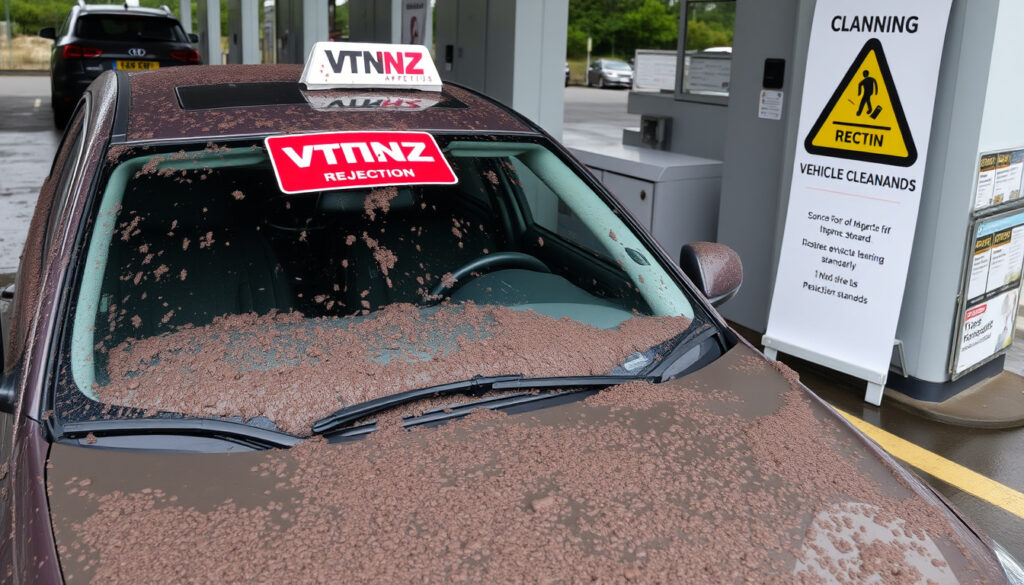
VTNZ Dirty Car Inspection Policy and Recent Rejections
Two dog owners in New Zealand recently learned the hard way that vehicle cleanliness is more than just aesthetics at inspection time. VTNZ, one of the country’s largest warrant of fitness providers, turned them away from WoF inspections because their cars contained too much dog hair.
Incident Date: 16 May 2025 · Customers Affected: Two · Reason for Rejection: Cars too dirty with dog hair · VTNZ Policy: Reserves right to reject unclean vehicles
Quick snapshot
- VTNZ can reject a vehicle if it is not clean and tidy (Otago Daily Times)
- Two customers were turned away in mid-May 2025 over dog hair contamination (Otago Daily Times)
- An inspector cited dog fur and sand as health and safety issues preventing inspection (Otago Daily Times)
- Whether VTNZ’s cleanliness enforcement varies across different inspection centres
- How frequently cleanliness-based rejections occur across the network
- Whether there’s a formal appeals pathway for vehicle owners who dispute cleanliness rejections
- 16 May 2025: VTNZ rejects two customers over dog hair contamination
- 17 May 2025: Press coverage appears in Otago Daily Times
- 1 November 2026: Major WoF frequency changes take effect nationwide
- Vehicle owners should clean interiors thoroughly before inspection visits
- WoF frequency changes from 2026 may reduce annual inspection visits per vehicle
- Clarity on specific cleanliness thresholds remains sparse from VTNZ directly
The following table summarises key facts about the VTNZ cleanliness policy and recent enforcement actions.
| Field | Detail |
|---|---|
| Organization | VTNZ |
| Service | Warrant of Fitness (WoF) Inspection |
| Rejection Trigger | Dog hair contamination deemed excessive |
| Policy Basis | Vehicle must be “clean and tidy” for inspection |
| Primary Sources | Otago Daily Times, RNZ, AA New Zealand, NZTA, Rova |
| WoF Failure Rate | Approximately 40% of NZ fleet fail at first attempt |
| New Vehicle WoF | First inspection at 3rd anniversary (4th from November 2026) |
Can You Get Fined for Having a Dirty Car?
New Zealand does not impose a specific financial penalty for owning a dirty car. There is no standalone fine for vehicle dirt in the NZ regulatory framework, and the Transport Agency’s enforcement mechanisms focus primarily on safety defects rather than cosmetic cleanliness.
However, the absence of a direct fine does not mean dirt carries no consequences. If a vehicle fails its WoF, the owner must repair defects and obtain a new warrant before driving. Driving with an expired WoF for more than two months will cost $350 from November 2026, up from the current $200 penalty (Rova). In that sense, dirt indirectly creates financial risk when it leads to inspection rejection.
Dubai operates far stricter rules, where drivers have faced fines and vehicle impoundment for accumulating excessive dust and debris on their cars. Those international examples illustrate that New Zealand’s approach is comparatively lenient on the cleanliness front—but the VTNZ incidents suggest inspectors have discretionary power to enforce standards that go beyond mere aesthetics.
NZ VTNZ Context
Within New Zealand, VTNZ inspectors can refuse to conduct a WoF if they determine the vehicle is too contaminated to assess properly. This is not a fine—it is a service refusal. The practical effect is the same: the vehicle owner leaves without a warrant and must return once the car is cleaned.
There is no NZ-specific fine for dirt alone, but a failed or refused WoF creates downstream costs: a missed appointment, a return trip, and potential exposure to the $350 expired-WoF penalty if the delay extends beyond two months.
What does VTNZ do?
VTNZ is one of New Zealand’s largest warrant of fitness inspection providers, operating dozens of testing centres across the country. Its primary role is conducting WoF inspections that verify a vehicle meets minimum safety standards for road use.
The WoF inspection itself is a comprehensive safety check covering brakes, lights, tyres, steering, suspension, and structural integrity. All vehicle inspectors must follow the NZ Transport Agency’s Vehicle Inspection Requirements Manual (VIRM), which sets out every aspect that must be assessed (NZ Transport Agency). It is the vehicle owner’s responsibility to keep their car in WoF-ready condition at all times.
Approximately 40% of New Zealand’s vehicle fleet fails its first WoF attempt, according to AA New Zealand (AA New Zealand). The majority of failures involve straightforward defects like faulty lights or worn wiper blades—issues entirely separate from cleanliness.
WoF Inspections
A WoF label is applied to the inside of the front windscreen on the driver’s side once a vehicle passes inspection (NZ Transport Agency). Vehicles first registered anywhere in the world on or after 1 January 2000 require annual WoF inspections for their lifetime. New vehicles currently receive their first WoF at the 3rd anniversary of first registration, extending to the 4th anniversary from 1 November 2026.
Safety Role
VTNZ states it reserves the right to reject a vehicle if it is not clean and tidy, if it is contaminated, or if it is impossible to access and properly inspect critical safety components. In the recent incidents, inspectors cited dog fur and sand as health and safety issues that prevented proper assessment of the vehicles.
“I’m sorry your son won’t be able to do the test today because your car’s too dirty. He said there’s dog fur and sand and we can’t do it. It’s a health and safety issue.”
— VTNZ instructor, as reported by Otago Daily Times
Why can’t you wash your car at home?
Many New Zealanders assume they can simply wash their car at home before an inspection, and in most cases this is perfectly legal. However, some regional restrictions do apply, particularly in Auckland where water conservation rules can limit outdoor hose use.
Auckland’s council regulations restrict certain types of outdoor water use, which has historically created confusion about whether residents can wash their vehicles at home. The rules are primarily environmental rather than safety-focused, and enforcement is inconsistent. For most New Zealanders outside water-restricted zones, a home wash with a garden hose is generally acceptable.
NZ Regulations
There is no nationwide ban on washing your car at home. The NZ Transport Agency and local councils do not impose cleanliness requirements beyond the WoF inspection context. Vehicle owners are expected to maintain their cars in a roadworthy state, which includes keeping them sufficiently clean for inspection purposes.
Environmental Rules
Commercial car washes operate under different environmental compliance requirements than residential washing. For vehicle owners who lack outdoor washing facilities or live in restricted zones, professional cleaning services offer an alternative—though at a cost. A full interior detail and wash in New Zealand typically costs between $80 and $150 depending on vehicle size and provider.
How much fine for a dirty car?
As noted above, New Zealand does not have a specific fine amount tied to vehicle dirt. The enforcement mechanism is administrative rather than penal: inspectors refuse the service, the owner must clean the vehicle and return.
However, VTNZ’s policy means that failing to present a clean vehicle for inspection can trigger a chain of costs. Beyond the immediate waste of an inspection fee and travel time, owners who cannot quickly resolve cleanliness issues risk their WoF expiring. The penalty for driving with a WoF expired more than two months rises to $350 from November 2026 (Rova).
Dubai Penalties
For context, Dubai imposes much harsher penalties for dirty vehicles, with fines that can reach several hundred dirhams and in some cases vehicle impoundment. These rules reflect different regulatory philosophies around public presentation of vehicles. New Zealand’s approach is more permissive but still allows individual inspection providers discretion over what constitutes an acceptable state of cleanliness.
NZ Implications
The practical NZ fine for dirt-related issues is essentially the cost of rescheduling and completing the inspection. Vehicle owners should view VTNZ’s cleanliness policy as a service requirement rather than a regulatory penalty. The real financial risk comes from WoF expiry resulting from extended delays caused by repeated rejections.
A single rejected inspection can cascade into weeks of driving without a valid WoF. For owners who cannot clean their vehicle immediately, the $350 expired-WoF penalty becomes a real risk—not because they drove a dirty car, but because the dirty car prevented them from getting certified.
Why Did VTNZ Turn Away Dirty Cars?
The incidents in May 2025 involved two separate customers who arrived at VTNZ centres with vehicles inspectors deemed too dirty to assess safely. In both cases, the primary contamination was dog hair—accumulated from transporting pets in the vehicles.
One VTNZ instructor reportedly told a customer that dog fur and sand were preventing inspection, citing health and safety concerns. The same instructor mentioned having rejected three other people the previous day for the same reason, suggesting that cleanliness enforcement is an ongoing practice rather than a one-off response.
Incident Details
The specific incidents involved vehicles with visible dog hair contamination on seats, floors, and interior surfaces. Inspectors reportedly determined that the contamination was sufficient to obstruct their ability to inspect safety-critical areas of the vehicle. While the vehicles may not have been mechanically unsafe, the inspectors applied VTNZ’s contamination policy to refuse service.
Customer Experiences
The affected customers were left without a WoF and faced the choice of cleaning their vehicles and returning for another inspection attempt. There is no publicly available information about whether either customer challenged the rejection or what outcome resulted from their return visits.
The broader pattern—multiple rejections in a short timeframe—suggests that VTNZ centres are actively applying their cleanliness policy rather than treating it as a theoretical provision. The implication: pet owners should treat vehicle cleanliness as a non-negotiable prerequisite before attending any WoF inspection.
Timeline
- 16 May 2025: Two customers turned away from VTNZ inspection centres for vehicles deemed too dirty with dog hair contamination
- 17 September 2025: Press coverage of the incidents appears in the Otago Daily Times
- 1 September 2025: Inspection frequency for vintage and veteran vehicles over 40 years old moves from 6-monthly to annual
- 1 September 2025: Major WoF changes take effect: vehicles 4–14 years old (registered from 2019) move to biennial inspections; new vehicles receive first WoF at 4 years; fines for unsafe tyres increase to $350
- 1 November 2027: Two-year WoF rule extends to vehicles registered from 2013
What We Know vs What We Don’t
Confirmed
- VTNZ policy allows rejection of vehicles that are not clean and tidy
- Dog hair and sand have been cited as specific contamination triggers
- Inspectors have discretion to determine whether a vehicle is too dirty for assessment
- The policy is applied consistently enough that multiple customers have been rejected in a short period
Unclear
- Whether cleanliness thresholds are standardised across all VTNZ locations or vary by inspector
- How often cleanliness-based rejections occur relative to actual safety defect failures
- Whether vehicle owners have any formal recourse to challenge a cleanliness rejection
- Whether VTNZ has published specific guidelines on what constitutes “too dirty”
Quotes
“VTNZ reserves the right to reject a vehicle if it is not in a clean and tidy state, it is contaminated or it is impossible to access and properly inspect critical safety components.”
— VTNZ policy statement, Otago Daily Times
“I’m sorry your son won’t be able to do the test today because your car’s too dirty. He said there’s dog fur and sand and we can’t do it. It’s a health and safety issue.”
— VTNZ instructor, Otago Daily Times
Summary
The VTNZ dog hair incidents reveal a gap between what most vehicle owners expect from their inspection and what the organisation is prepared to accept. For pet owners, the lesson is practical: before arriving for a WoF, vacuum thoroughly, remove pet hair from all surfaces, and ensure the interior is clean enough that an inspector can access safety components without obstruction. There is no published cleanliness threshold from VTNZ, which means the safest approach is to present a vehicle that is obviously and unmistakably clean. For New Zealanders planning their next WoF, the choice is straightforward: detail the car first, or risk a rejected inspection, a wasted trip, and potentially weeks of driving without a valid warrant.
Related reading: ATV Crash Foxton Beach – Teen Dies in Fatal Rollover · Mag and Turbo Hamilton – Fatal Attack Facts and Updates
To avoid VTNZ rejections over dirt or dog hair during WoF checks, many drivers first use a convenient drive-through car wash for quick thorough cleaning.
Frequently asked questions
Does VTNZ require a clean car for WoF?
Yes. VTNZ states it reserves the right to reject a vehicle if it is not clean and tidy, contaminated, or impossible to inspect properly due to access issues. Vehicle cleanliness is part of their inspection standards.
What counts as too dirty for VTNZ inspection?
There is no published exact threshold. However, VTNZ has specifically cited dog fur and sand as contamination that prevented inspections. The determination appears to be at the inspector’s discretion based on whether they can properly assess safety components.
Can dog hair cause VTNZ rejection?
Yes. In May 2025, two customers were turned away specifically because their vehicles contained excessive dog hair. VTNZ cited dog fur as a health and safety issue that blocked inspection.
How should I prepare my car for VTNZ?
Remove all personal items from seats and floors. Vacuum thoroughly, paying special attention to pet hair in carpets and seat crevices. Wipe down all interior surfaces and clean windows inside and out. Ensure the boot is accessible if it contains safety equipment. Basically, present the vehicle in a state that would allow a stranger to inspect every corner without obstruction.
Is there a fine for a dirty car at VTNZ?
There is no direct fine for presenting a dirty vehicle, but if the inspection is refused and your current WoF expires before you can return with a cleaned vehicle, you face a $350 penalty for driving with an expired WoF (over two months) from November 2026.
What happens if VTNZ refuses my inspection?
You leave without a WoF and must return once the vehicle is cleaned. You are not fined directly, but you incur the cost of rescheduling and potentially additional travel. If your current WoF expires during the delay, you cannot legally drive the vehicle.
Can I appeal a VTNZ cleanliness rejection?
There is no publicly documented appeals process specifically for cleanliness-based rejections. The policy is applied at the inspector’s discretion. If you believe a rejection was unjustified, your options are to clean the vehicle and return, or escalate to VTNZ customer service for review.
More related posts
 Under the Red Verandah Menu: Dog Friendly Cafe Info
 Kyle Allen (Actor) – From Ballet to Hollywood Star
 Prime Video NZ Cost 2025: Pricing, Discounts & Is It Worth It
 45 AUD to NZD – Current Rate, Trends and Best Providers
 How to Play UNO: Official Rules, Setup & Step-by-Step Guide
 Free Things to Do in Rotorua: Top Attractions
 Travel Insurance for a Trip – Essential Coverage Guide