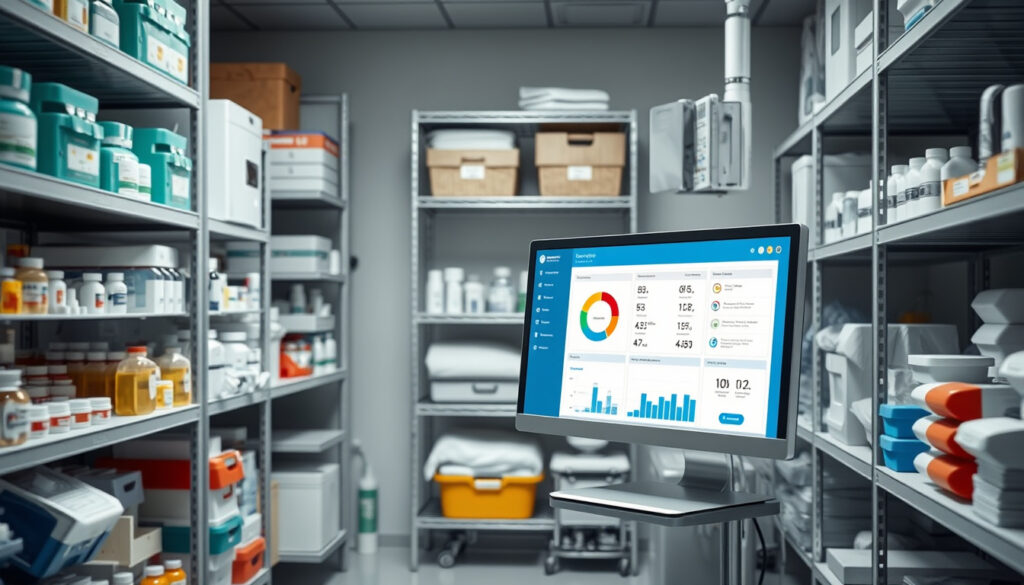
Inventory Management Software for Hospitals: Top Options
Hospital supply shortages cause delayed procedures, cancelled surgeries, and compromised patient care. Hospital inventory management software provides the automated tracking and real-time visibility that replaces spreadsheets and guesswork.
Main Types of Systems: 4 · Key Efficiency Rule: 80/20 · Common Methods: FIFO, FEFO · Top Free Options Listed: 6 (2026 forecast)
Quick snapshot
- 4 types of inventory management systems exist per standard definitions (Capterra medical inventory software directory)
- Most used healthcare software varies significantly by facility size and specialty (HUB Healthcare care coordination platform)
- 2026 rankings now list 6 top free medical inventory options including Sortly, mymediset, and LabCollector LIMS (Capterra free medical inventory software listings)
- EHR integration capabilities are becoming the key differentiator for hospital inventory tools (GetApp third-party integration review)
| Label | Value |
|---|---|
| Primary Use | Medical supplies and pharmaceuticals |
| Key Methods | FIFO, FEFO, 80/20 |
| Common Features | Cloud-based, photo tracking |
What is the inventory management system in a hospital?
A hospital inventory management system tracks medical supplies, pharmaceuticals, and equipment from the moment they arrive at the loading dock until they reach the patient or expire on the shelf. Unlike retail or warehouse inventory software, hospital systems must account for expiration dates, lot numbers, recall traceability, and strict regulatory compliance.
Core components
- Real-time stock level monitoring across multiple locations and storage areas
- Automated reorder alerts calibrated to consumption patterns and lead times
- Expiration date tracking to prevent expired medications or supplies from reaching patients
- Lot and serial number traceability for FDA recall responses
- Integration with electronic health record (EHR) systems for clinical workflow alignment
Role in healthcare operations
HUB Healthcare’s medical inventory management software provides real-time visibility into inventory levels to mitigate risks associated with stock imbalance. The system includes automated reordering framework calibrated to precise threshold levels for steady availability of essential supplies. Digital medical inventory management systems reduce manual errors and enhance operational efficacy through automated processes.
A single stockout of a critical surgical implant or lifesaving medication can delay patient care and trigger costly emergency orders. Hospital inventory software eliminates that risk by keeping supply levels balanced automatically.
What is hospital inventory management and how does it work?
Hospital inventory management is the process of tracking, organizing, and replenishing medical supplies across departments and facilities. It combines barcode scanning, cloud databases, and automated workflows to replace manual counting and guesswork.
Tracking and reordering processes
When a nurse scans an item to administer it, the system automatically decrements that supply from the relevant location’s count. When stock falls below a preset threshold, the software generates a reorder alert or—even better—submits a purchase order directly to the supplier. OpenEMR is a free, open-source EHR and practice management system certified by ONC that supports charting, patient scheduling, and basic billing service capabilities. OpenEMR features a fully integrated electronic health record, practice management, scheduling, electronic billing, and free support.
Automation features
Xero’s inventory management software automates tasks like invoicing and reporting to save time and reduce manual error. HUB Healthcare’s inventory management includes capabilities to monitor expiration dates and lot numbers for compliance and safety of perishable medical items. Structured inventory categorization and tracking by location and vendor improves organizational ease in medical facilities.
What are the 4 types of inventory management system?
Four main categories of inventory management systems are recognized across industries, and hospitals apply each differently depending on supply type and clinical need.
FIFO overview
FIFO stands for “First In, First Out.” The oldest stock gets used first, which is essential for time-sensitive items like IV fluids, surgical kits with sterile expiration dates, and refrigerated medications. OpenMRS is a free, open-source electronic medical record system designed to support healthcare delivery for medical practices with limited resources. This approach minimizes waste from expired supplies and is the standard in most hospital pharmacies and supply rooms.
Other methods like FEFO
FEFO—”First Expired, First Out”—prioritizes items closest to expiration regardless of when they arrived. This is critical for blood products, vaccines, and compounded medications where date precision directly affects patient safety. ASAP Systems is an inventory management software specifically designed for the medical industry with capability to track perishable items.
The 80/20 rule in inventory applies to hospital settings by identifying which 20% of supplies account for 80% of usage and cost. Facilities concentrate monitoring and reorder automation on high-turnover items like syringes, gauze, and common medications, while applying less rigorous tracking to low-volume specialty equipment.
What software is best for inventory management?
The best hospital inventory management software depends on facility size, budget, and existing EHR infrastructure. Cloud-based solutions are preferred because they allow multi-location tracking without costly on-premise servers.
Top options for hospitals
Sortly is described as the industry’s simplest mobile-friendly medical inventory system trusted by thousands of businesses. Sortly’s medical inventory management software enables seamless tracking of healthcare supplies and medical equipment across multiple locations. FlexScanMD is a cloud-based inventory management system offering integrations with leading EHR and Practice Management systems. GNU Health is built for healthcare teams and includes core inventory tools with support for compliance with common medical rules.
Features like photo tracking
Photo-based inventory logging lets staff visually confirm what they have on hand without manual count entry. Sortly and Softr both support photo uploads tied to individual item records, making audits faster and more accurate. Softr enables building of free medical supply inventory software with no-code solution that syncs live data and manages permissions. Softr’s medical inventory platform maintains SOC2 and GDPR compliance with robust permission controls for sensitive inventory data protection.
For mid-sized hospitals already running a major EHR platform, FlexScanMD offers direct integrations that Sortly and general-purpose tools lack.
| Software | Cost | Key Feature | EHR Integration |
|---|---|---|---|
| Sortly | Free tier available | Mobile-friendly, photo tracking | Limited |
| FlexScanMD | Subscription | Cloud-based, multi-location | Leading EHR systems |
| GNU Health | Free, open-source | Compliance tools built in | Community modules |
| ASAP Systems | Subscription | Perishable item tracking | API available |
The implication: mid-sized hospitals with existing EHR infrastructure benefit most from FlexScanMD’s native integrations, while smaller facilities can start with Sortly’s free tier.
Is there a free software for inventory management?
Yes, several free and freemium options exist for hospitals with limited budgets, though each comes with trade-offs around features, support, and compliance certifications.
Free options for hospitals
Free medical inventory software options listed on Capterra for 2026 include mymediset, LabCollector LIMS, SurgiCare Medical Inventory, Sortly, Provet, DocVilla, Sowingo, and Asset Infinity. CharmHealth is a cloud-based EHR and practice management system with free tier for up to 50 patient encounters per month and paid plans starting at $25 per month. OpenEMR can run on Windows, Linux, Mac OS X, and other platforms with options for on-location, own servers, or cloud-based deployment.
Limitations and alternatives
Completely free solutions like OpenEMR and OpenMRS are open-source and carry no licensing fees, but they require self-hosting and technical expertise to maintain. OSCAR EMR is an open-source electronic medical record system developed at McMaster University with core features including patient record management, appointment scheduling, medical billing, e-prescribing, and secure messaging. Freemium tools like CharmHealth and Sortly offer free tiers that work for small practices but hit usage caps that large hospital networks quickly outgrow.
| Software | Cost | Platform | Best For |
|---|---|---|---|
| OpenEMR | Free, open-source | Windows, Linux, Mac, cloud | ONC-certified EHR with inventory |
| CharmHealth | Free up to 50 encounters/month; $25+/month paid | Cloud | Small practices needing EHR |
| Sortly | Free tier; premium plans | Mobile, cloud | Multi-location tracking |
| Softr | Free tier; premium plans | No-code, cloud | Building custom dashboards |
| GNU Health | Free, open-source | Self-hosted | Compliance-focused facilities |
| ASAP Systems | Subscription | Cloud | Perishable medical items |
What this means: open-source tools eliminate licensing costs but require in-house technical capacity, while freemium commercial options lower upfront expenses at the cost of encounter caps that hospital-scale operations outgrow within months.
Upsides
- Reduces supply waste through expiration tracking
- Automates reordering to prevent stockouts
- Enables multi-location visibility from a single dashboard
- Supports regulatory compliance with lot-number traceability
- Free and freemium options available for budget-conscious facilities
Downsides
- Implementation requires staff training and workflow changes
- Free open-source tools need IT expertise to maintain
- Freemium tiers impose usage caps unsuitable for large hospitals
- Integration with legacy EHR systems can be complex
- Subscription costs add up for multi-facility deployments
The clear picture on hospital inventory software
Four types of inventory management systems are in routine use across healthcare facilities, and hospitals lean heavily on FIFO and FEFO methods to keep perishable supplies from expiring before they reach patients. The market now includes at least six credible free or freemium options for 2026, ranging from fully open-source platforms like OpenEMR and GNU Health to mobile-friendly tools like Sortly and no-code builders like Softr. OpenEMR holds a particular advantage as the only ONC-certified free EHR with integrated practice management and inventory capabilities.
Open-source tools save licensing fees but demand in-house technical expertise. Commercial freemium options cost less upfront but impose encounter caps that hospital-scale operations outgrow within months.
OpenEMR is a free and open-source electronic health records and medical practice management application that is certified by ONC.
— EHR in Practice (Healthcare Technology Publication)
HUB Healthcare emerges as a leader in this field, offering sophisticated medical inventory management software designed to streamline the inventory management process, thus allowing medical professionals to devote their energy and resources to patient care.
— HUB Healthcare (Medical Inventory Software Provider)
Related reading: Inventory Management Software Built for Hospitals · Free Medical Inventory Management Software
getfreed.ai, ehrinpractice.com, practiceehr.com, softr.io, sortly.com, youtube.com, getapp.com
Frequently asked questions
What is the most used software in healthcare?
Usage varies by facility type and size. Large hospital networks commonly deploy enterprise EHR platforms like Epic or Cerner, while smaller practices often use open-source EHRs like OpenEMR. For inventory-specific software, Sortly and FlexScanMD have strong footprints in mid-sized healthcare facilities.
Which inventory methods matter most for hospitals?
Hospitals rely primarily on FIFO (First In, First Out) and FEFO (First Expired, First Out) to prevent expired medications or supplies from reaching patients. The 80/20 rule also applies, concentrating monitoring and reorder automation on the 20% of supplies that account for 80% of usage.
What is inventory management software with photos?
Photo-enabled inventory software lets staff attach images to supply records, making audits faster and visual confirmation more reliable. Sortly and Softr both support photo attachments, allowing teams to visually verify stock without opening every drawer or cabinet.
What is a digital inventory management system?
A digital inventory management system replaces paper logs and spreadsheet tracking with cloud databases, barcode scanning, and automated alerts. In hospitals, these systems track supply levels, monitor expiration dates, generate purchase orders, and integrate with EHR platforms for clinical workflow alignment.
What are inventory management companies?
Inventory management companies develop and sell software tools that help organizations track, organize, and reorder supplies. In healthcare, relevant companies include Sortly, FlexScanMD, Xero, ASAP Systems, HUB Healthcare, Softr, and open-source projects like OpenEMR, GNU Health, and OpenMRS.
More related posts
 Agriculture Tools in Bhuj: Best Dealers & Contacts
 West Ham vs Tottenham 2026: Match Report & Scarf Ban
 Love It or List It 2026: Pay, Host Changes, and Status
 New Zealand Dollar to Sri Lankan Rupees: Today’s Rate & Guide
 Cast of Once Upon a Time in Hollywood: Actors & Roles
 Galaxy Z Fold 4 to Buy: Price, Trade-In, Fold 5 Comparison
 6 Seater Round Dining Table NZ: Prices, Materials & Where to Buy