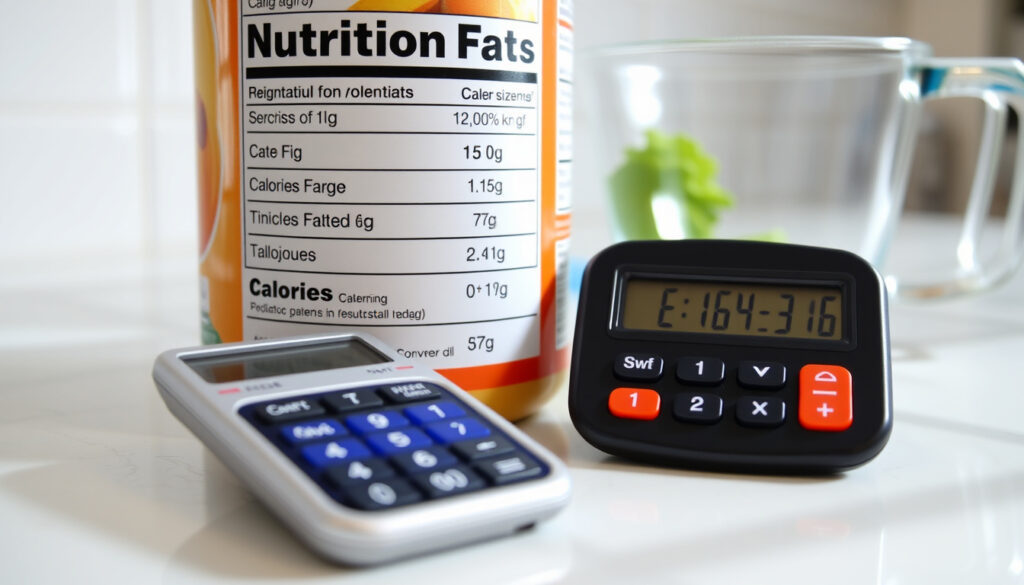
How to Convert kJ to Calories: Simple Formula & Calculator
If you’ve ever looked at a nutrition label in Australia or the UK and wondered how those kilojoules translate to the calories you’re used to, you’re not alone. The conversion is simpler than it seems, but the difference between the two units trips up plenty of people. Once you know the exact factor — 1 calorie equals 4.184 kilojoules — you’ll never guess again.
1 calorie (kcal): 4.184 kilojoules ·
1 kilojoule: 0.239 calories ·
Rough mental shortcut: divide kJ by 4 to get calories ·
Average daily energy need: 8,700 kJ (≈ 2,080 calories)
Quick snapshot
- 1 calorie (kcal) = 4.184 kJ (The Calculator Site (nutrition conversion resource))
- 1 kJ = 0.239 food calories (RapidTables (energy conversion reference))
- Australia/UK labels use kJ; US labels use calories (general nutrition labelling standard) (The Calculator Site (nutrition conversion resource))
- No major uncertainties — the conversion is well established (RapidTables (energy conversion reference))
- The main confusion is between “small” calories and food Calories (kcal) (RapidTables (energy conversion reference))
- The exact factor can vary slightly for different calorie definitions (e.g., thermochemical vs. 15°C), but 4.184 is standard for food energy (RapidTables (energy conversion reference))
- No new regulatory changes; the 4.184 factor has been standard for decades (The Calculator Site (nutrition conversion resource))
- Growing use of kJ in fitness apps and wearables (market trend observation) (The Calculator Site (nutrition conversion resource))
- More countries may shift to kJ as metric adoption increases
- Consumers should learn both units for global food tracking
Key facts at a glance
Here’s a quick reference table summarizing the most important conversion figures.
| Label | Value |
|---|---|
| Exact conversion factor | 1 cal = 4.184 kJ |
| 1 kJ = | 0.239 cal |
| Rough rule | Divide kJ by 4 to get cal |
| Daily reference (adult) | ~8,700 kJ / 2,080 cal |
How do I convert kJ to calories?
The simplest method is to multiply kilojoules by 0.239 to get calories. For example, 500 kJ × 0.239 = 119.5 calories. The reverse is just as easy: multiply calories by 4.184 to get kilojoules.
The simple formula: kJ × 0.239 = calories
- Formula from RapidTables (engineering conversion tool): E(Cal) = E(kJ) × 0.239
- For food calories (kcal), this is exact when using 0.2390057
- Rounded to three decimals, 0.239 is accurate enough for everyday use
Step-by-step conversion example (500 kJ to calories)
- Start with 500 kJ
- Multiply by 0.239: 500 × 0.239 = 119.5
- Result: 500 kJ = 119.5 kcal (food calories)
- For rough mental math: 500 ÷ 4 ≈ 125 calories — close enough for a quick estimate
Using a calculator vs mental math
Online calculators from Blua by Bupa (health insurer converter) and The Calculator Site (nutrition conversion resource) handle the exact multiplication. Mental math using ÷4 gives a 5% overestimate but works in a pinch.
The implication: Knowing both the exact and rough methods allows you to choose the right level of precision for your situation.
Is 1 kJ one calorie?
No — and the difference matters. 1 kJ equals roughly 0.239 calories, meaning one calorie is about 4.2 times larger than one kilojoule.
Why 1 kJ is not 1 calorie
Kilojoules and calories are both energy units but on different scales. A standard food calorie (kcal) is the energy needed to heat 1 kg of water by 1 °C. A kilojoule is defined by mechanical work — 1 kJ equals 1000 joules. The two are related by 4.184, not 1.
Magnitude difference: 1 kJ ≈ 0.239 calories
As confirmed by Blua by Bupa (health insurer calculator), 1 kJ = 0.2390057 large/food calories. That means a 2000 kJ energy bar contains only about 478 calories — a huge difference if you mix up the units.
Common misconception explained
Some people assume kilojoules and calories are interchangeable because both appear on food labels. “The terms are not interchangeable,” notes Ideal Nutrition (dietitian-run resource). Using the wrong factor can throw off meal plans by a factor of four.
Treat kJ and calories as separate languages. A 2000-kJ meal is about 478 calories; a 2000-calorie meal is 8368 kJ. Confusing them means missing your energy target by 75%.
The catch: Assuming a 1-to-1 ratio leads to massive energy miscalculations in meal planning.
What is the difference between kilojoules and calories?
Both measure energy, but they come from different measurement systems and are used in different parts of the world.
Origin of each unit: metric vs imperial
- Calorie – part of the imperial (or cgs) system; historically defined as heat required to raise 1 g of water by 1 °C
- Kilojoule – SI (metric) unit; 1 kJ = 1000 joules, where 1 joule is the work done by 1 newton over 1 metre
- Adopted by most countries for official nutrition labelling, except the United States
When kilojoules are used vs calories
Australia, New Zealand, the UK, and most of Europe display energy as kilojoules on packaged foods. The US and Canada still use calories. Travelers and international meal planners need both.
Conversion factor relationship
One calorie equals 4.184 kJ exactly — a relationship established by The Calculator Site (nutrition conversion resource). That means you can convert either direction with a single multiplication.
Why this matters: A 2000-calorie daily target equals 8368 kJ. If you mistakenly use the 4.0 shortcut, you’d think 2000 calories is 8000 kJ — a difference of 368 kJ, or about 88 calories. That error accumulates over a week.
Is 200 kcal the same as 200 calories?
Yes — and this is where unit labels on food packages cause the most confusion.
Understanding kcal vs calorie on food labels
In nutrition science, 1 kilocalorie (kcal) equals 1000 small calories (cal). But food manufacturers write “Calories” (capital C) to mean kilocalories. So 200 kcal on a label is exactly 200 food Calories. The Calculator Site (nutrition conversion resource) clarifies: “When people say calories in the context of food, they are referring to kilocalories.”
Why 1 kcal = 1 Calorie (food calorie)
- 1 small calorie (cal) = energy to heat 1 g water by 1 °C
- 1 kilocalorie (kcal) = 1000 small calories = 1 food Calorie
- On US labels, “Calories” always means kcal
Common confusion with small vs large calorie
If you see “200 calories” on a snack bar, the correct scientific reading is 200 kcal — that is, 200,000 small calories. The RapidTables (energy conversion reference) includes separate formulas for large/food calories and small/thermochemical calories to avoid this mix-up.
Nutrition science uses the same word for two different magnitudes. A “calorie” on a package is 1000× bigger than a “calorie” in a physics textbook. That’s why athletes and dietitians always write “kcal” or “Cal” to stay precise.
What this means: When reading a label, you can safely treat “Calories” and “kcal” as identical units.
How many kJ are 1000 calories?
Exactly 4184 kJ — but the quick mental shortcut is 4000 kJ. Let’s compare precise vs. rough.
Calculation: 1000 calories × 4.184 = 4184 kJ
Using the standard factor from Blua by Bupa (health insurer calculator): 1000 cal × 4.184 = 4184 kJ. This is the official conversion for dietary energy.
Rough mental conversion: 1000 cal ≈ 4000 kJ
Dividing or multiplying by 4 instead of 4.184 gives an error of about 4.4%. For a 1000-calorie meal, that’s a 184 kJ difference — roughly 44 calories. Ideal Nutrition (dietitian team) recommends the 4.0 shortcut only for “back-of-napkin” estimates.
Practical examples: 1000-calorie meal in kJ
| Meal | Calories | kJ (exact × 4.184) | kJ (rough × 4) |
|---|---|---|---|
| Large burger + fries | 1000 | 4184 kJ | 4000 kJ |
| Two slices of pizza + soda | 800 | 3347 kJ | 3200 kJ |
| Grilled chicken salad + dressing | 500 | 2092 kJ | 2000 kJ |
The pattern: the 4.0 shortcut consistently undercounts actual energy by about 4.5%. That’s small per meal but adds up to an extra 300 kJ per day if you use the rough rule for all three meals.
Comparison: Kilojoules vs Calories
This table highlights the key differences between kilojoules and calories across several dimensions.
| Aspect | Kilojoules (kJ) | Calories (kcal) |
|---|---|---|
| System | Metric (SI) | Imperial / cgs |
| Used in | Australia, UK, Europe, NZ | USA, Canada |
| Common daily reference | 8,700 kJ | 2,080 calories |
| Conversion to the other | 1 kJ = 0.239 cal | 1 cal = 4.184 kJ |
| On food labels | kJ (sometimes + kcal) | Calories (meaning kcal) |
| Typical snack bar | ~450-600 kJ | ~107-143 calories |
The pattern: Choosing which unit to use depends entirely on your location and the labeling standard in place.
Step-by-step conversion guide
- Identify the unit you have. If it’s kJ, go to step 2a; if it’s calories, go to step 2b.
- a) kJ → calories: multiply by 0.239 (or 0.2390057 for extreme precision).
b) calories → kJ: multiply by 4.184. - Get a calculator (smartphone works) unless you’re comfortable with the ÷4 rough method.
- Write down the result and label it correctly — “calories” or “kJ”.
- Double-check using the reciprocal: for example, if you got 500 kJ = 119.5 cal, reverse to 119.5 × 4.184 = 500 kJ.
Following these steps ensures you never mix up the units or misread a label.
What the experts say
“This calculator converts between Calories and kilojoules, rounded to the nearest whole number.”
Blua by Bupa (health insurer)
“For a rough conversion when you’re out and about, divide the number of kilojoules by four to get the calories.”
Summary: What this means for your daily tracking
The 4.184 conversion factor is not negotiable — it’s baked into every nutrition database and food label worldwide. If you track calories or kilojoules, using the exact multiplier (0.239 or 4.184) keeps your numbers consistent across apps, labels, and countries. For the average adult aiming for 8,700 kJ (2,080 calories) per day, the difference between the rough ÷4 rule and the exact factor is about 87 kJ per meal. Over a month, that’s enough to misrepresent your intake by a full day’s worth of energy. For anyone serious about meeting a specific body-composition or performance goal, the choice is clear: use the exact factor, or plan for the drift.
Related reading: RapidTables – Kilojoules to Calories Conversion Calculator · The Calculator Site – kJ to Calories Conversion Guide
wikihow.com, youtube.com, wellbeingeorge.com.au, trainerroad.com
Frequently asked questions
How many kJ are 1200 calories a day?
1200 calories × 4.184 = 5020.8 kJ. A 1200-calorie diet equals roughly 5020 kJ per day.
How much is 2000 calories in kJ?
2000 calories × 4.184 = 8368 kJ. This is the standard reference for an adult daily intake.
How many kJ are in 1 calorie?
1 calorie (food calorie, kcal) = 4.184 kilojoules exactly.
Why do some countries use kilojoules instead of calories?
Countries that adopted the metric system (SI) for food labelling use kilojoules. The US retains calories because it has not mandated metric-only labelling.
What is a kilocalorie?
A kilocalorie (kcal) is 1000 small calories. On food labels, “Calorie” with a capital C means kilocalorie.
How many calories are in a 2000 kJ meal?
2000 kJ × 0.239 = 478 calories. A 2000 kJ meal is roughly 478 food calories.
More related posts
 Tata Steel Share Price: Buy, Hold, or Sell
 Star of the Seas: Size, Features, Cost & Family Tips (2025)
 How to Draw a Cow: Step-by-Step Tutorial for All Ages
 Crispy Pork Belly Recipe: Oven, Air Fryer, and More
 Kyle Allen (Actor) – From Ballet to Hollywood Star
 Where to Find Cheap Textbooks: Top Comparison Sites
 Agriculture Tools in Bhuj: Best Dealers & Contacts
 Signs of Liver Disease: Early Symptoms & Warning Signs