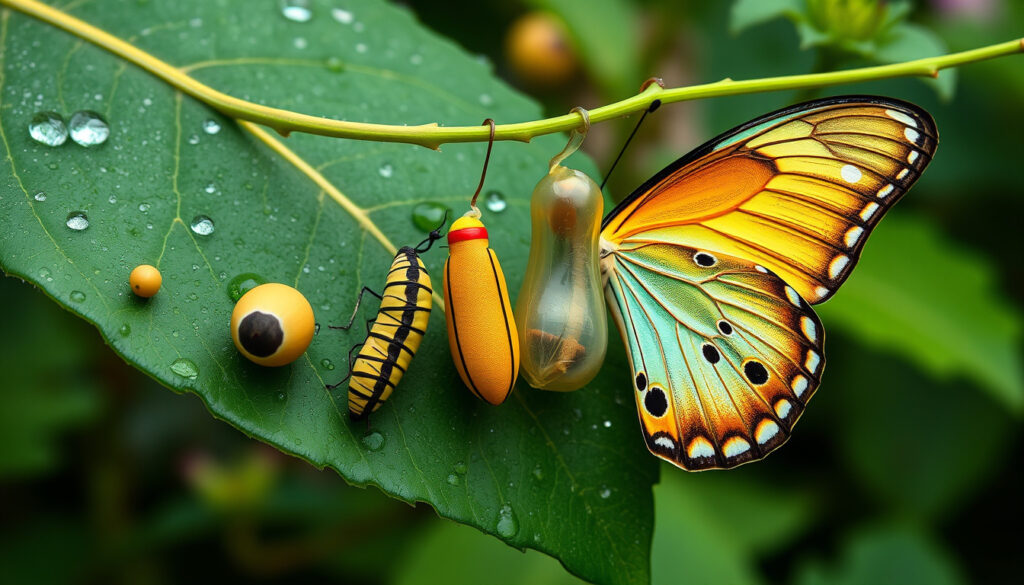
Life Cycle of a Butterfly – 4 Stages From Egg to Adult
Butterflies undergo one of nature’s most remarkable transformations, progressing through four distinct stages that bear virtually no resemblance to one another. This biological process, known as complete metamorphosis, represents an extraordinary feat of cellular reorganization that has captivated scientists and nature enthusiasts for centuries. From a tiny egg smaller than a pinhead to a fully-formed winged insect capable of long-distance migration, the butterfly life cycle demonstrates the incredible adaptability of insect life across diverse environments worldwide.
Understanding this cycle provides insight into how butterflies exploit different ecological niches at each stage, minimizing competition between larvae and adults while maximizing survival rates. The transformation involves the dissolution and reconstruction of body tissues at the cellular level, orchestrated by specialized cells that remain dormant during the larval phase. This process enables butterflies to occupy entirely different ecological roles as caterpillars and adults, reducing intraspecies competition and allowing populations to thrive in varied habitats.
The duration of each stage varies considerably depending on species, temperature, food availability, and environmental conditions, with some species completing their entire development in as little as one month while others require nearly a full year. Climate plays a particularly significant role in determining development speed, with warmer conditions generally accelerating metabolic processes throughout all phases of growth.
What Are the 4 Stages of a Butterfly’s Life Cycle?
The butterfly life cycle consists of four consecutive stages: egg, larva, pupa, and adult. Each phase serves a specific biological function, with larvae focused primarily on growth and feeding while adults concentrate on reproduction and dispersal. This division of labor has proven remarkably successful, with over 17,500 butterfly species distributed across every continent except Antarctica. The following overview grid illustrates the fundamental characteristics of each stage, providing a foundation for understanding the complete metamorphic process.
3-4 days typical
Laid on host plant leaves by female
2-4 weeks typical
Constantly feeding and growing
10-14 days typical
Complete internal transformation
2-4 weeks typical
Reproduction and dispersal
- Butterflies belong to the order Lepidoptera, which includes both butterflies and moths sharing the same four-stage metamorphosis.
- Larvae may consume up to 99% of their total lifetime food intake during the feeding stage.
- Complete metamorphosis contrasts sharply with the three-stage process found in grasshoppers and similar insects.
- Imaginal discs—specialized cells present in larvae—enable the dramatic anatomical reconstruction during pupation.
- Adults and larvae occupy entirely different ecological niches, eliminating direct competition for resources between life stages.
- The pupal stage involves the loss of more than 50% of the caterpillar’s body mass as tissues dissolve and reform.
- Some butterfly species overwinter as pupae, remaining in this stage for up to two years under adverse conditions.
| Stage | Duration | Key Changes | Behavior |
|---|---|---|---|
| Egg | Days | Embryo develops inside protective shell | Stationary; female selects host plant |
| Larva | Weeks to months | 100x size increase; multiple molts | Constant feeding; energy storage |
| Pupa | Days to 2 years | Tissue dissolution; adult structures form | Inactive externally; dynamic internally |
| Adult | Days to 11 months | Wings expand and harden | Flying; feeding; mating; egg-laying |
Egg Stage
The butterfly life cycle begins when a mature female locates an appropriate host plant and deposits her eggs, typically attaching them to leaves, stems, or other suitable surfaces. These eggs measure approximately one millimeter in radius and display considerable variety in shape—some appear oval, others round, and many adopt cylindrical forms depending on the species. The female possesses an innate ability to identify correct host plants through chemical cues, ensuring that emerging larvae will have immediate access to appropriate food sources upon hatching. Each egg contains a single embryo surrounded by protective membranes that shield the developing insect from environmental hazards and potential pathogens.
The duration of the egg stage varies according to species and ambient temperature, with many varieties hatching within a few days under favorable conditions. Some temperate species time their egg laying to coincide with spring growth, with hatching occurring weeks later when adequate food becomes available. The female typically lays eggs individually or in small clusters, distributing them across multiple plants to reduce predation risks and ensure that at least some offspring survive. Environmental factors including humidity, temperature fluctuations, and exposure to sunlight all influence developmental speed during this vulnerable initial phase.
Larva (Caterpillar) Stage
Upon hatching, the larva—commonly called a caterpillar—emerges by consuming its own eggshell, a behavior that provides essential nutrients for the challenging journey ahead. The newly hatched caterpillar appears remarkably small, often measuring just a few millimeters in length, yet possesses an extraordinarily voracious appetite that drives its rapid growth trajectory. In certain species such as the Apollo butterfly, hatchlings display distinctive black coloration marked with orange spots, creating effective camouflage against the host plants where they feed. The caterpillar’s primary mission during this stage involves continuous consumption, with the animal’s mouthparts specifically adapted for shredding and ingesting plant material with remarkable efficiency.
Growth occurs in discrete increments as the caterpillar’s rigid exoskeleton cannot expand continuously, necessitating periodic molting where the old skin splits and is shed to accommodate the enlarging body. Most caterpillars molt between four and five times before reaching full size, with each intermediate stage called an instar. During this process, the caterpillar not only increases in size but may also undergo subtle changes in coloration or pattern that provide additional protection from predators. Energy consumed during this phase is stored as fat and other nutrients, providing the fuel necessary for the dramatic transformation that awaits in the subsequent pupal stage.
Pupa (Chrysalis) Stage
When the caterpillar reaches full size, it ceases feeding and seeks a sheltered location suitable for pupation—a process that signals the beginning of the most dramatic phase of the life cycle. The transformation site varies among species: some caterpillars attach themselves to plant stems or leaf undersides, others bury themselves in soil, and some construct underground chambers where the vulnerable transformation can occur undisturbed. Once positioned, the caterpillar forms a hardened protective shell called a chrysalis, creating a dormant-appearing structure that conceals the most profound biological reorganization found anywhere in the natural world.
Externally, the chrysalis appears motionless, yet within this protective casing, the caterpillar’s body essentially liquefies as digestive juices break down most tissues into a cellular soup. Specialized cell clusters called imaginal discs—tiny populations of undifferentiated cells that have remained dormant throughout the larval stage—now activate and begin constructing adult structures. These imaginal discs give rise to wings, legs, compound eyes, antennae, and all other features characteristic of the adult butterfly, assembling an entirely new anatomical configuration from the dissolved materials of the larval body. The chrysalis may change color as development progresses, with many species developing visible wing patterns visible through the translucent casing in the days preceding emergence.
Adult Stage
The adult butterfly emerges by splitting open the chrysalis casing, typically using a specialized structure to weaken and rupture the protective shell. Upon first emerging, the butterfly appears quite different from the elegant flier commonly envisioned: its wings remain crumpled and wet, folded against a body that must now complete several critical physiological processes before flight becomes possible. The newly emerged adult hangs upside down from its empty chrysalis or nearby support, allowing gravity to assist as hemolymph—the insect equivalent of blood—pumps through the tubular veins of the wings. This hydraulic pressure gradually inflates the wings from their compact folded state, expanding them to their full size in a process that may require up to two hours to complete.
Once the wings have fully expanded and begin to dry and harden, the butterfly achieves its characteristic form and becomes capable of flight. The adult stage serves the critical biological functions of reproduction and dispersal, with mating behaviors and egg-laying ensuring the continuation of the species to subsequent generations. Many adult butterflies feed on nectar from flowering plants, contributing to pollination services that benefit both natural ecosystems and agricultural systems. However, some species do not feed at all during adulthood, relying entirely on energy reserves accumulated during the larval feeding phase to fuel their brief adult existence.
How Long Does a Butterfly’s Life Cycle Last?
The complete duration of a butterfly’s life cycle spans anywhere from approximately one month under optimal conditions to nearly a full year for species adapted to temperate or seasonal environments. This remarkable variation reflects evolutionary adaptations that allow different species to synchronize their development with favorable seasons, food availability, and other ecological factors specific to their native habitats. Tropical species often complete multiple generations within a single year, while temperate species may require a full calendar year or longer to move through all four stages, particularly when overwintering in the pupal or adult stage during harsh winter months.
Each individual stage exhibits its own duration range that responds to environmental variables including temperature, humidity, and food quality. Warmer conditions generally accelerate development across all stages by increasing metabolic rates, while cooler temperatures slow biological processes and extend the time required for each transition. The availability and nutritional quality of host plants directly affects larval growth rates, with well-fed caterpillars typically developing faster and more robustly than those facing food scarcity. Photoperiod—the length of daylight hours—serves as an important environmental cue for many species, triggering developmental changes and dormancy responses that help synchronize the life cycle with seasonal patterns.
Species in temperate regions often enter dormancy during winter, with some remaining in pupal stage for up to two years before emerging. This adaptation ensures adult butterflies emerge during appropriate seasons when nectar sources and mating opportunities are available.
What Is Metamorphosis in Butterflies?
Metamorphosis refers to the biological process through which an organism undergoes dramatic physical transformation between distinct life stages, and in butterflies, this process represents one of the most remarkable examples found in the animal kingdom. The term derives from Greek roots meaning “transformation” or “change of form,” perfectly capturing the essence of what occurs as a caterpillar transforms into a butterfly through the pupal stage. This biological phenomenon enables a single species to exploit completely different ecological niches during different phases of its life, with larvae adapted for intensive feeding and growth while adults specialize in reproduction and dispersal.
Complete Metamorphosis Explained
Complete metamorphosis, scientifically termed holometabolism, distinguishes butterflies and their Lepidoptera relatives from insects that undergo incomplete development. This process involves four distinct life stages—egg, larva, pupa, and adult—that differ dramatically in morphology, behavior, and ecological role. During the pupal stage, the larval body undergoes nearly complete histological dissolution, with most tissues breaking down into a cellular mass from which adult structures subsequently form. This radical reconstruction allows for the emergence of features that serve entirely different functions than those present during the larval phase, including compound eyes, wings, and reproductive organs absent in the caterpillar.
The evolutionary innovation of complete metamorphosis provides several significant advantages over simpler developmental pathways. By separating the feeding and growth functions of larvae from the reproductive activities of adults, butterflies avoid direct competition between immature and mature individuals of the same species for identical resources. This division of ecological niches enables populations to sustain higher densities than would be possible if all life stages competed for the same food sources. Additionally, the dormant pupal stage allows species to survive seasonal adversity by entering developmental pause, or diapause, until environmental conditions become favorable again for adult activity.
Key Changes in Each Stage
The transition from egg to larva involves the differentiation of embryonic cells into the specialized tissues required for independent existence outside the protective egg case. Hatching caterpillars must immediately begin feeding to fuel the rapid growth that characterizes the larval stage, consuming their eggshells to recover valuable nutrients before commencing their work as herbivorous feeding machines. Throughout subsequent molts, the caterpillar’s internal anatomy progressively develops toward the pupal condition, with imaginal discs for adult structures gradually increasing in size and complexity beneath the larval integument.
The pupal stage represents the most dramatic transformation, during which the organized body plan of the caterpillar dissolves and reforms into the fundamentally different architecture of the adult butterfly. Imaginal discs—clusters of undifferentiated cells that have persisted throughout larval development—now receive hormonal signals triggering their activation and rapid proliferation. These disc cells differentiate into specific tissue types and migrate to their appropriate positions, constructing wings from the wing imaginal discs, legs from the leg discs, and the elaborate proboscis for nectar feeding from specialized mouthpart discs. The result emerges as a flying insect bearing virtually no anatomical resemblance to the crawling creature that entered the pupal stage.
Imaginal discs enable this remarkable change by remaining as undifferentiated cell clusters throughout larval development. When triggered during pupation, these cells rapidly multiply and specialize to construct adult features from the dissolved larval tissues.
What Occurs in the Pupa or Chrysalis Stage?
The pupal stage represents a period of apparent stillness that conceals extraordinary biological activity, as the caterpillar’s body undergoes controlled autolysis while simultaneously constructing the adult butterfly from imaginal disc populations. The chrysalis, formed from shed larval skin that hardens into a protective casing, shields this internal reorganization from external pressures while remaining permeable to atmospheric oxygen necessary for cellular respiration. As tissues break down, the caterpillar loses more than half its body mass, with released materials providing building blocks and energy for the construction of adult anatomical structures.
The timing of adult emergence depends on species-specific genetic programs modulated by environmental conditions, with development progressing through predictable stages visible to careful observers. Color changes within the chrysalis often signal approaching emergence, as the developing adult’s wing patterns become visible through the thinning pupal case. When development completes, the adult butterfly releases enzymes that weaken the chrysalis casing, typically emerging in the morning hours when temperatures favor wing expansion and drying. The entire emergence process requires careful choreography, with the butterfly hanging upside down to facilitate wing inflation while gravity assists hemolymph circulation through the wing veins.
How Does a Butterfly Emerge from the Chrysalis?
Emergence begins when the adult butterfly releases special enzymes to weaken and split the pupal case, typically at a predetermined seam that separates the chrysalis into two roughly equal halves. The butterfly pushes through this weakened opening using muscular contractions of its abdomen, emerging headfirst while still encased in a thin protective membrane called the pupal skin. Upon complete emergence, the butterfly hangs motionless from its empty chrysalis or a nearby support structure, positioning itself upside down to exploit gravity’s assistance for wing expansion.
Hemolymph fills the wing veins rapidly, creating hydraulic pressure that unfolds the crumpled wing surfaces to their full dimensions. This inflation process resembles filling a collapsed balloon with air, expanding the delicate membrane structure from its compact folded state into flat wing surfaces capable of generating aerodynamic lift. The butterfly continues hanging motionless as its wings dry and the delicate tissue structures strengthen, typically requiring between fifteen minutes and two hours before the wings become stiff enough for safe flight. Once flight becomes possible, the butterfly embarks on its adult mission of feeding, mating, and laying eggs to initiate the next generation’s life cycle.
The Butterfly Life Cycle Timeline
The progression from egg to adult follows a roughly sequential timeline that varies in absolute duration but maintains consistent stage ordering across all butterfly species. Understanding this timeline helps researchers, educators, and enthusiasts anticipate developmental milestones and provide appropriate care for captive specimens. The following ordered list presents the major events and approximate timing for a typical temperate butterfly species under favorable conditions.
- Days 1-5: Egg stage—female deposits eggs on appropriate host plant; embryo develops within protective casing.
- Days 5-7: Hatching—caterpillar emerges, typically consuming the eggshell for initial nutrition.
- Weeks 1-4: Active feeding—caterpillar consumes host plant leaves extensively, growing rapidly through multiple instars.
- Weeks 4-6: Pupation—caterpillar seeks shelter, attaches to surface, and forms chrysalis; internal transformation begins.
- Weeks 6-8: Metamorphosis—imaginal discs activate and construct adult structures from dissolved larval tissues.
- Week 8-9: Emergence—adult breaks free from chrysalis, hangs motionless while wings inflate and dry.
- Weeks 9-12: Adult activity—butterfly feeds on nectar, locates mates, and lays eggs to begin subsequent generation.
Many variables influence actual timing, with tropical species often completing their cycles more rapidly while temperate species may extend specific stages across multiple months. Some species enter diapause during unfavorable seasons, pausing their development for extended periods until conditions improve. Researchers studying butterfly populations use these developmental timelines to predict emergence dates, plan conservation interventions, and understand population dynamics in various habitats.
The Apollo butterfly provides one example of species-specific timing, with its eggs hatching in April through June, caterpillars molting five times before underground pupation lasting approximately two months, and a total lifecycle of roughly three months under typical conditions.
Comparing Butterfly and Moth Life Cycles
Butterflies and moths share the identical four-stage complete metamorphosis, representing close evolutionary relationship within the order Lepidoptera despite their apparent differences in appearance and behavior. Both groups begin as eggs laid on appropriate host plants, progress through feeding larval stages as caterpillars, transform within protective pupal casings, and emerge as winged adults capable of reproduction. This fundamental similarity reflects their common ancestry and the evolutionary success of complete metamorphosis as a developmental strategy.
Key distinguishing features separate adult butterflies from moths, with the most obvious involving pupal structure and daily activity patterns. Butterfly pupae form exposed chrysalides without silk coverings, often featuring decorative bumps and geometric patterns that provide camouflage against predators. Moths, in contrast, typically spin protective silk cocoons that enclose their pupal cases, providing additional insulation and physical protection during the vulnerable transformation period.
Most butterfly species fly during daylight hours while remaining inactive at night, whereas the majority of moth species exhibit nocturnal activity patterns. Antennae shape also differs consistently: butterflies possess clubbed antennae with thickened tips, while moths typically display feathery or thread-like antennae without obvious enlargement.
Predators and Survival Challenges
Predation represents a significant mortality source throughout all four stages of the butterfly life cycle, with each phase facing distinct predatory threats that have driven the evolution of various defensive adaptations. Eggs and young caterpillars experience particularly high predation rates from birds, wasps, spiders, and ants that actively hunt these small, vulnerable creatures among foliage. The rapid growth rates observed in caterpillars may represent an evolutionary response to this predation pressure, with natural selection favoring individuals that develop quickly to reach the more defended pupal stage before succumbing to predators.
Pupae face reduced but still significant predation risks, particularly from birds and invertebrates capable of reaching exposed chrysalides attached to vegetation or structures. Cryptic coloration, disruptive patterns, and cryptic positioning among environmental features provide some protection, while harder pupal casings resist predation attempts from smaller attackers. Adult butterflies encounter diverse predators including birds, spiders, and bats, though their mobility and often cryptic or aposematic coloration provide some defense. The relatively short adult lifespan in many species may represent an adaptive response to this ongoing predation pressure, with natural selection favoring rapid reproduction before individuals fall victim to their many natural enemies.
What We Know and What Remains Uncertain
Scientific research has established several fundamental facts about butterfly metamorphosis with high confidence, grounded in extensive observation, experimental study, and repeated verification across numerous species. All butterflies without exception undergo complete metamorphosis through the four-stage sequence of egg, larva, pupa, and adult, with this pattern representing a defining characteristic of the entire order Lepidoptera. The cellular mechanisms underlying transformation, including the role of imaginal discs and hormonal regulation, have been extensively documented through microscopy, experimental manipulation, and molecular analysis.
| Established Information | Areas of Uncertainty |
|---|---|
| Four distinct life stages in all butterfly species | Precise genetic mechanisms controlling stage transitions |
| Imaginal discs enable adult structure formation | Complete list of hormonal interactions |
| Complete metamorphosis differs from incomplete | Why certain species enter extended diapause |
| Duration varies by species and environment | Climate change impacts on development timing |
| Larvae consume most lifetime food | How populations adapt to shifting conditions |
Considerable uncertainty persists regarding specific details of development in particular species, optimal environmental conditions for rare varieties, and the precise mechanisms controlling certain behavioral aspects of the life cycle. Species-specific duration ranges represent averages calculated from limited sample sizes, with individual development potentially deviating substantially from these norms based on unique circumstances. Climate change introduces additional uncertainty by altering historical patterns and creating novel selective pressures whose long-term effects on butterfly populations remain difficult to predict with precision.
The Evolutionary Significance of Butterfly Metamorphosis
Complete metamorphosis evolved as a key innovation in insect evolution, providing substantial adaptive advantages that contributed to the remarkable diversification of holometabolous insects including butterflies, moths, beetles, flies, and bees. The separation of feeding and reproductive functions into distinct life stages eliminated competition between larvae and adults while enabling each stage to evolve specialized adaptations for its specific ecological role. This modularity effectively doubled the evolutionary potential of affected lineages, allowing separate optimization of juvenile and adult body plans without compromising the functionality of either phase.
The presence of imaginal discs—persistent populations of undifferentiated cells retained throughout larval development—enabled the evolution of complete metamorphosis by providing building materials for adult structures even as surrounding tissues dissolved during pupation. This cellular mechanism represents a crucial prerequisite for holometabolous development, and its evolutionary origin marked a major branching point in insect phylogeny. Modern butterflies and moths represent the product of hundreds of millions of years of refinement of this developmental system, with contemporary species demonstrating extraordinary diversity in size, color, behavior, and ecological specialization.
Sources and Scientific Perspectives
Scientific understanding of butterfly metamorphosis derives from contributions spanning centuries of observation, experimentation, and technological advancement in biological research methods. Early naturalists documented basic stage sequences and external morphological changes, while later researchers employed microscopy to investigate cellular processes and genetic techniques to probe molecular mechanisms underlying developmental transitions. Contemporary research continues to refine scientific understanding of these complex processes through application of advanced imaging technologies, molecular genetics, and computational modeling approaches.
“Butterflies undergo complete metamorphosis, featuring four separate, dramatically different stages where the larva’s body largely dissolves into a ’tissue cell soup’ to form adult structures like wings and legs.”
— Florida Museum of Natural History, Educational Resources
Major scientific sources consulted for this overview include natural history museums, university entomology departments, and established educational institutions with documented expertise in Lepidoptera biology. These organizations maintain ongoing research programs investigating various aspects of butterfly development, ecology, and conservation, contributing to a continuously expanding body of scientific knowledge regarding these fascinating insects.
Summary
The life cycle of a butterfly encompasses four remarkable stages—egg, larva, pupa, and adult—each characterized by distinct anatomical features, behaviors, and ecological roles. Complete metamorphosis enables this transformation through the dissolution and reconstruction of body tissues, with imaginal discs providing the cellular foundation for adult structure formation. Duration varies extensively among species and responds to environmental conditions, with total cycles ranging from approximately one month to nearly one year. Understanding these developmental stages provides valuable insight into butterfly ecology, evolution, and conservation needs, supporting efforts to protect these pollinators and their habitats for future generations. For readers interested in related natural science topics, the article on Rice Water for Hair – Benefits, Recipe and How to Use offers information on natural hair care, while How to Secure Home WiFi – Key Steps for Strong Protection addresses practical digital security measures.
Frequently Asked Questions
What do butterflies eat during each life stage?
Caterpillars feed exclusively on host plant leaves, consuming approximately 99% of their lifetime food intake during this stage. Adult butterflies primarily feed on nectar from flowering plants, though some species may not feed at all during their brief adult existence, relying entirely on energy stored during the larval phase.
How does a butterfly emerge from the chrysalis?
The adult butterfly releases enzymes that weaken the chrysalis casing, then pushes through the split using abdominal muscular contractions. Upon emerging, it hangs upside down while hemolymph pumps through wing veins, inflating crumpled wings to their full size. Wings require up to two hours to fully expand and harden before flight becomes possible.
What is the difference between complete and incomplete metamorphosis?
Complete metamorphosis involves four distinct stages with a dramatic transformation during the pupal phase, where the larval body largely dissolves and reforms. Incomplete metamorphosis, found in grasshoppers and similar insects, includes only three stages without a true pupal phase, with nymphs gradually developing adult features through successive molts.
How long does each stage of the butterfly life cycle last?
Eggs typically last days, larvae persist for weeks to months, pupae remain for days to nearly two years, and adults live from days to approximately eleven months. Actual duration depends on species, temperature, food availability, and other environmental factors, with tropical species generally completing cycles faster than temperate species.
What happens during the egg stage of butterfly development?
The female butterfly lays tiny eggs, usually around one millimeter in diameter, on appropriate host plants selected through chemical recognition. The embryo develops inside the protective shell while the egg remains stationary, with hatching typically occurring within days under favorable temperature conditions.
Why do caterpillars shed their skin during growth?
Caterpillar exoskeletons cannot expand continuously like skin, necessitating periodic molts where the old cuticle splits and is shed. Each molt allows growth to resume until the new, larger skin hardens, with most caterpillars undergoing four to five molts before reaching full size and entering pupation.
What are imaginal discs and what is their function?
Imaginal discs are clusters of undifferentiated cells that persist throughout larval development without specializing into larval tissues. During pupation, these discs receive hormonal signals triggering their activation, causing them to multiply and differentiate into adult structures including wings, legs, eyes, and antennae.
More related posts
 What Is a Reusable Straw Made Of? Materials & Safety Guide
 Mercer Bay Loop Walk: Duration, Difficulty & Safety Tips
 Best Airlines in the World 2025-2026: Top Rankings & Safety Guide
 The Big Bang Theory Guide: Hit Sitcom Facts (2007-2019)
 Hamilton Blue Bag Delivery – How to Order Free Replacements
 RV Super Centre Christchurch | Motorhomes, Sales & Service in Christchurch
 Live Funeral Services Today – Platforms and Viewing Guide
 Tom Phillips Daughter Pregnant: Rumor vs Reality