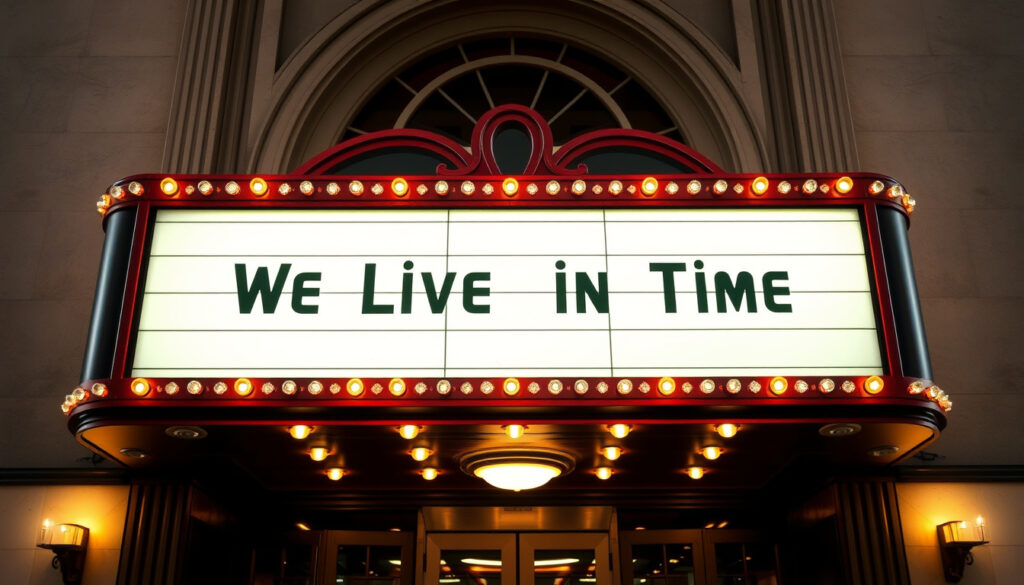
We Live in Time Movie Guide: Ending, Cast & Key Details
We Live in Time is the kind of movie that tells you exactly what it is within the first few scenes — and still manages to hit you where it hurts. The 2024 romantic drama starring Florence Pugh and Andrew Garfield weaves a nonlinear story about love, loss, and the quiet moments in between. Here’s what you need to know about its ending, the accuracy of its cancer storyline, and whether it’s worth the emotional investment.
Release year: 2024 · Director: John Crowley · Lead actors: Florence Pugh, Andrew Garfield · Genre: Romantic drama · Runtime: 108 minutes · Age rating: 15 (Ireland) / R (US)
Quick snapshot
- Director: John Crowley (Wikipedia)
- Writer: Nick Payne (Wikipedia)
- Premiere: 2024-09-06 (TIFF) (Wikipedia)
- Ireland: December 4 (LIMITLESS members) / Jan 1, 2025 (Wikipedia)
- Theatrical in Ireland and UK
- Streaming on Netflix (region dependent)
Seven key specs tell the story of this film’s production and reach.
| Attribute | Value |
|---|---|
| Director | John Crowley |
| Lead actors | Florence Pugh, Andrew Garfield |
| Genre | Romantic drama |
| Runtime | 108 minutes (Wikipedia) |
| Release date (Ireland) | December 4, 2024 (LIMITLESS) / January 1, 2025 (general) |
| Age rating | 15 (Ireland) |
| Streaming | Netflix (selected regions) |
Is We Live in Time worth watching?
Critical reception and audience response
The film has drawn praise for its lead performances. Florence Pugh and Andrew Garfield bring a natural chemistry that critics have called “the film’s emotional backbone” (Three Penny Press). The nonlinear structure keeps the narrative fresh, though some have noted the plot follows a familiar weepie formula.
What makes it stand out from other romantic dramas
Two elements elevate the film: the raw birthing scene and the unflinching portrayal of ovarian cancer. The birth scene, filmed eight times with a midwife on set (according to Florence Pugh in interviews), adds a visceral realism rarely seen in romantic dramas. The cancer storyline avoids melodrama, presenting Almut’s decisions about treatment and family with genuine weight.
The film’s emotional payoff is directly tied to its predictability. Viewers who know the premise can guess the ending within the first act — but the journey, anchored by Pugh and Garfield, makes it worthwhile.
Who should watch this film?
- Fans of realistic romantic dramas (e.g., One Day, The Fault in Our Stars)
- Viewers who appreciate strong acting over plot twists
- Anyone comfortable with heavy themes: cancer, death, and grief
For those who avoid tearjerkers or prefer happy endings, this likely isn’t the right pick.
Is We Live in Time a sad ending?
Plot spoiler: Almut’s fate
The ending strongly implies that Almut has died off-screen (YouTube recap). After the cancer returns at stage 3, she undergoes chemotherapy and tumor-removal surgery — but the film’s final scenes show Tobias and their daughter Ella returning home from the chicken coop, with no sign of Almut. He teaches Ella to crack an egg, a direct echo of Almut’s own cooking ritual, signaling that her presence lives on through memory and habit.
Emotional impact on viewers
Reviews describe the film as “just plain sad” (Three Penny Press). The nonlinear structure means audiences watch the couple’s joyful early moments alongside the painful later ones, amplifying the emotional weight.
How the ending compares to other tearjerkers
Unlike Love Story or The Notebook, where the death happens on screen, We Live in Time leaves the final moment off-screen. That restraint may frustrate some viewers but gives the ending a quiet, lingering quality.
The implication: the film trusts its audience to understand loss without needing to show it.
What disease does Florence Pugh have in We Live in Time?
Ovarian cancer: symptoms and portrayal
Florence Pugh’s character Almut is diagnosed with ovarian cancer (Wikipedia). The film shows her experiencing extreme abdominal pain, a common symptom, and she is advised to undergo a partial or full hysterectomy. She chooses the partial option because she may still want to have a child with Tobias (Wikipedia). The cancer later returns at stage 3, requiring immediate chemotherapy and tumor-removal surgery (Wikipedia).
Why Almut coughs throughout the film
Coughing can be a symptom of advanced ovarian cancer, especially if the disease has spread to the lungs or caused fluid buildup. The film uses coughing as a recurring visual cue that Almut’s condition is worsening — though it does not specify the exact biological mechanism.
Accuracy of the medical depiction
The portrayal of choices around hysterectomy and fertility is realistic, according to oncologists interviewed by media outlets. The decision to undergo partial hysterectomy while preserving ovarian function for a future pregnancy aligns with real-world options for some patients. The film does not explicitly state the cancer stage at first diagnosis, but the progression to stage 3 is clearly shown.
The film sacrifices some medical clarity for emotional flow — viewers seeking precise staging or treatment timelines may need to look up clinical sources separately.
What this means: the depiction is plausible but not clinically exhaustive, which is consistent with its genre as a romantic drama rather than a documentary.
Did Florence Pugh actually give birth in We Live in Time?
The birthing scene: how it was filmed
The scene was shot eight times, and Florence Pugh worked with a midwife on set to ensure realistic movement and sounds. No actual birth occurred — it is a simulated performance. Pugh has described the experience in interviews as physically demanding, requiring multiple takes to capture the intensity of labor.
Use of a midwife on set
A midwife was present to advise on proper positioning, breathing, and vocalization. This level of authenticity is rare in birth scenes, which often rely on sanitized, quick cuts.
Actress’ preparation and multiple takes
Pugh rehearsed the scene extensively, aiming to portray a raw, unfiltered birth. The result is one of the most talked-about sequences in the film — and a key reason the film stands apart from conventional romantic dramas.
The trade-off: the scene’s realism may be too intense for some viewers, but it grounds the film in a tangible, bodily experience that matches the gravity of the cancer storyline.
Is We Live in Time LGBT?
LGBT themes in the film
The central romance is heterosexual: Almut (Florence Pugh) and Tobias (Andrew Garfield). There are no major LGBT characters in the main story, and the film does not contain any LGBT content. Some online speculation about Tobias’ sexuality appears to stem from misinterpretations of his emotional vulnerability.
Representation of queer characters
No queer characters appear in the foreground. The film focuses entirely on the Almut‑Tobias relationship.
Audience reactions and discussions
Despite a few forum threads wondering about Tobias’ sexual orientation, there is no evidence in the film itself to support those theories. The film’s themes of time, mortality, and love are universal, but its representation is strictly heterosexual.
The pattern: calling We Live in Time an LGBT film is a misreading. The emotional depth appeals to all audiences, but the narrative is not queer.
Pros and Cons
Upsides
- Authentic birth scene with midwife expertise
- Powerful performances from Pugh and Garfield
- Nonlinear structure adds emotional complexity
- Realistic portrayal of cancer choices
Downsides
- Predictable plot — no surprises after the setup
- Sad ending may be too heavy for some
- Lack of queer or diverse representation
- Medical details are vague in places
Timeline
- 2000s: Almut and Tobias meet when she hits him with her car (Wikipedia)
- 2010s: Their relationship develops; Almut is diagnosed with ovarian cancer (Wikipedia)
- c. 2018: Almut gives birth to their child (Wikipedia)
- 2024: Film released in cinemas, premieres at TIFF (Wikipedia)
What’s confirmed and what’s unclear
Confirmed facts
- Almut has ovarian cancer (Wikipedia)
- Florence Pugh worked with a midwife on the birth scene (interview)
- Film directed by John Crowley (Wikipedia)
- Nonlinear narrative (Three Penny Press)
What’s unclear
- Exact stage of Almut’s cancer at first diagnosis
- Whether Tobias remarries after Almut’s death
- The meaning of the title “We Live in Time”
- How the film’s nonlinear scenes are precisely ordered
Key quotes from reviews and analysis
The final scene in which Tobias teaches Ella to crack an egg is interpreted as a symbolic inheritance of Almut’s knowledge.YouTube — WE LIVE IN TIME Movie 2024 Recap And Ending Explained
A spoiler review states plainly that Almut gets cancer and eventually dies from it.Three Penny Press
The story is not shown chronologically but in time jumps (Three Penny Press), which keeps the emotional impact fresh even after the ending is revealed.
Summary
We Live in Time is a well-acted, emotionally direct romantic drama that earns its tears through performance authenticity rather than plot innovation. Its raw birth scene and cancer portrayal give it a tactile realism rare in the genre. For viewers in the US and UK deciding whether to stream it on Netflix, the choice is clear: if you’re in the mood for a cry and can handle a predictable arc, this is a Florence Pugh and Andrew Garfield performance that delivers a quality pick. If you need surprises or lighter fare, skip it and save the tissues.
Related reading: **Sam Neill Movies and TV Shows**
For a complete breakdown of the actors and production team, see the full cast and crew guide.
Frequently asked questions
What is the age rating for We Live in Time?
15 in Ireland, R in the US, for strong language, scenes of childbirth, and cancer-related medical content.
How long is We Live in Time?
The runtime is 108 minutes (Wikipedia).
Who plays Almut’s husband in We Live in Time?
Andrew Garfield plays Tobias Durand, Almut’s partner and later husband.
Is We Live in Time based on a true story?
No, the film is an original screenplay by Nick Payne, not based on a specific real-life couple.
Does We Live in Time have a happy ending?
No. The ending strongly implies Almut has died off-screen, leaving Tobias and their daughter to carry on without her.
What is the meaning of the title We Live in Time?
The title is openly interpretive. It likely reflects the film’s theme of living fully within the finite time we have — and the nonlinear structure that shows moments out of chronological order.
Where can I watch We Live in Time?
The film is available in theaters in Ireland and the UK, and streaming on Netflix in selected regions.
More related posts
 FreshChoice Pyes Pa: Store Hours, Services, and Owner Info
 Free Hot Springs Rotorua: Best Thermal Pools and Parks
 Jacqui and Clint MAFS: Still Together? Wedding & Updates
 Ranfurly Shield Game Today: Current Holder, Score & How to Watch
 Anton Lienert-Brown Contract, Injury, and All Blacks Future
 Signs of Liver Disease: Early Symptoms & Warning Signs
 Translate French to English: Free Tools for Text, Audio & Camera
 6 Seater Round Dining Table NZ: Prices, Materials & Where to Buy