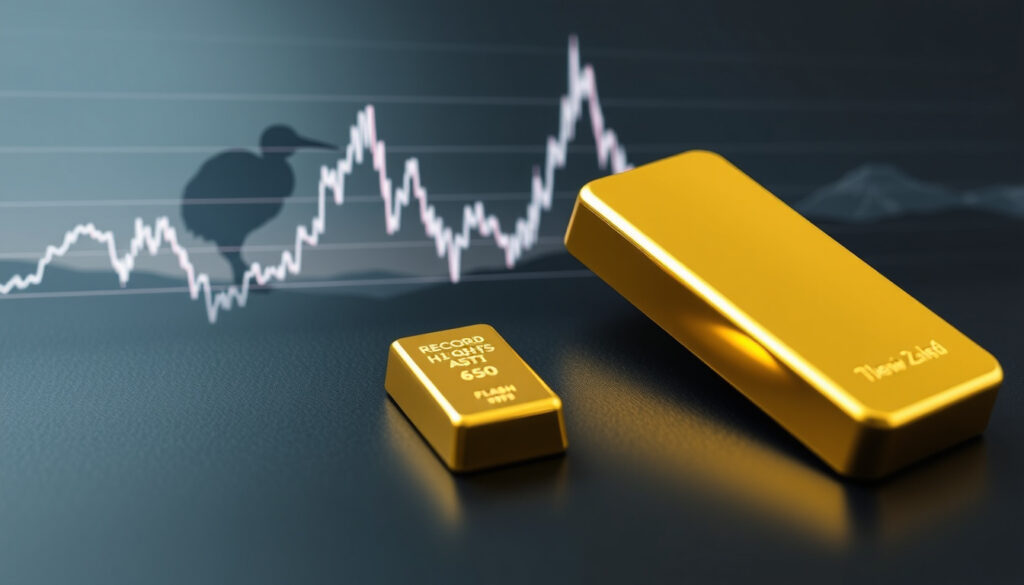
Kiwi Gold Price Spikes: Record Highs, Flash Crash & NZ Impact
There’s a moment in any gold rush when the phone rings off the hook at a local dealer — and that’s exactly what happened in New Zealand as gold punched through US$5,000 an ounce in late January 2026. The rally pushed the Kiwi price above NZ$8,700 before a brutal flash crash erased US$15 trillion from the market in a single day.
Record price (Jan 2026): US$5,089/oz ·
Flash crash decline: 20% ·
Increase since 2024: 76% ·
Predicted peak 2026: US$5,500/oz ·
Kiwi spot price (mid-Jan): NZ$8,716
Quick snapshot
- Gold broke US$5,000/oz on January 26, 2026 (US Gold Bureau (precious metals market data))
- NZ gold peaked near NZ$8,716/oz (YouTube: IT’S HAPPENING New Zealand! (local market coverage))
- Whether gold will reach US$5,500 by year-end 2026
- If US$10,000 by 2030 is realistic
- Jan 26: US$5,089/oz record (US Gold Bureau) · Feb 2: 20% crash (The Spinoff) · Feb 15: Kiwi gold rush reported (NZ Herald)
- Goldman Sachs forecasts US$5,400/oz; deVere sees US$10,000 by 2030
Why is the gold price soaring?
The rally that pushed gold past US$5,000 didn’t happen in a vacuum. It was powered by a perfect storm: inflation fears, geopolitical tension, central bank buying, and a weakening US dollar — all feeding a safe-haven stampede. For New Zealand investors, the currency added fuel: the NZ dollar’s slide against the greenback amplified every price move, pushing local prices to once-unthinkable levels.
Why are kiwi gold prices spiking today?
The New Zealand gold price hit NZ$8,716 per ounce in late January, according to analysis from YouTube: IT’S HAPPENING New Zealand! (local market tracker). That represented a staggering 69% annual gain. Dealers across Auckland reported they couldn’t keep 1oz coins or bars in stock. The NZ dollar’s weakness — it dropped against the USD during the same period — meant Kiwi buyers paid a premium even as the global spot price climbed.
What caused the gold price shock?
- Safe-haven demand: Talk of 100% US tariffs on Canada for China trade spiked uncertainty in January 2026, according to US Gold Bureau (precious metals market analysis).
- Central bank buying: Central banks around the world continued accumulating gold at record pace, a structural driver that doesn’t fade quickly.
- Weakening US dollar index: The dollar weakened even as gold hit records — an unusual deviation from normal safe-haven patterns, as The Spinoff (NZ current affairs outlet) noted, citing Stuff’s analysis.
- Inflation persistence: Sticky inflation and political pressure on the US Federal Reserve kept real interest rates low, supporting gold.
New Zealanders chasing gold are paying a hidden tax: the NZD’s slide against the USD means every ounce costs more in local currency — even if the global spot price stalls.
Why is the gold price falling now?
On February 2, 2026, everything flipped. Gold dropped 9% in a single session. Silver plunged nearly 30% — its worst day since 1980. The trigger wasn’t a single news headline but a cascade of margin calls and leveraged positions unwinding. The scale was historic: over US$15 trillion in market value evaporated in 24 hours, according to The Spinoff (citing news.com.au’s reporting).
What is the current gold price in NZ?
After the crash, the NZ gold price fell roughly 20% from its NZ$8,716 peak, settling closer to NZ$7,000. As of mid-February 2026, prices had begun to recover, though dealers reported continued volatility. One Auckland dealer told the NZ Herald (New Zealand’s largest daily) that prices were still around US$5,300 — roughly NZ$8,268 — but volumes had thinned.
The crash exposed a vulnerability: leveraged speculators drove the spike, and when margin calls hit, the correction was brutal. For Kiwi retail buyers, the lesson is that liquidity can vanish faster than a price ticker.
The pattern: when speculative bets dominate, a 15% January rally can be wiped in hours. But the structural forces — central bank demand, inflation concerns — remain intact, which explains why analysts expect a recovery.
Is gold going to hit 5000?
It already did. The question now is whether the recovery will push gold higher. On January 26, 2026, gold peaked above US$5,100 before settling at US$5,089, as recorded by US Gold Bureau (market data firm). The flash crash pulled it back, but the trend line points up.
Could gold hit $10,000 an ounce?
US Gold Bureau (citing Goldman Sachs’ research) reported that Goldman Sachs raised its 2026 target to US$5,400 per ounce, citing structural demand. Some analysts see US$6,000-plus by year-end if low interest rates and geopolitical tensions persist. A senior analyst at deVere Group forecasts US$10,000 by 2030 — a scenario that would require sustained currency debasement and central bank accumulation.
Will gold rate fall in 2026?
Philip Newman, a director at Metals Focus, predicts gold could peak at US$5,500 later in 2026. But the flash crash is a warning: even a bullish year can deliver 20% drawdowns. The 76% gain since 2024 (US Gold Bureau data) suggests the trend is powerful, but the crash proves no asset climbs in a straight line.
The trade-off: a US$10,000 target by 2030 is mathematically possible — it implies roughly 12% annual returns — but only if inflation fears and currency instability persist. If the Fed pivots or geopolitical tensions ease, that path narrows sharply.
Should I hold or sell my gold now?
For Kiwi investors who watched gold soar to NZ$8,716 and then crash 20%, the instinct to lock in profits is strong. But the decision depends on your time horizon and your cost basis. Let’s break it down with a real example.
What if I invested $1000 in gold 10 years ago?
A NZ$1,000 investment in gold a decade ago — when prices were around NZ$2,700/oz — would be worth approximately NZ$3,200 today, based on the February 2026 recovery price. That’s a 220% return, far outpacing term deposits. But it also means the investor endured multiple 15-25% drawdowns along the way.
| Scenario | NZ$1,000 invested | Value Feb 2026 | Return |
|---|---|---|---|
| 2016 gold at NZ$2,700/oz | NZ$1,000 | ~NZ$3,200 | +220% |
| 2024 gold at NZ$4,920/oz | NZ$1,000 | ~NZ$1,770 | +77% |
| Jan 2026 peak (NZ$8,716/oz) | NZ$1,000 | ~NZ$1,000 (held) | +0% (post-crash recovery) |
Three investor profiles, one pattern: short-term holders got whipsawed by the crash; long-term holders still sit on significant gains.
Upsides
- Gold has delivered 220% over 10 years — strong inflation hedge
- Central bank buying provides structural support
- NZD weakness amplifies local gold returns
- Analysts see US$5,500-6,000 by year-end 2026
Downsides
- 20% flash crash in February 2026 proves volatility
- US$15 trillion wiped in one day — liquidity risk
- Selling gold in NZ may trigger tax on gains
- If NZD strengthens, local returns could undershoot
For Kiwi investors, the recommendation from analysts is consistent: hold for the long term but be cautious about short-term entry points. If you bought near the peak, the recovery path is uncertain. If you have held for years, the crash is a speed bump, not a reversal.
Timeline: Key dates in the Kiwi gold spike
- January 26, 2026: Gold hits record US$5,089/oz; NZ price surpasses NZ$8,700 (US Gold Bureau)
- February 2, 2026: Flash crash: gold drops 9%, silver 30%; US$15 trillion wiped (The Spinoff)
- February 4, 2026: Auckland dealer reports prices at US$5,300 as market stabilizes (NZ Herald)
- February 15, 2026: 1News reports Kiwi gold rush — job quitting and claim disputes emerge
- 2026 (projected): Analysts see potential peak at US$5,500; Goldman Sachs targets US$5,400 (US Gold Bureau)
The pattern: each phase of the rally accelerated faster than the last, and corrections hit with equal force. For long-term holders, the February crash is a reminder that volatility is the price of breakthrough returns.
Confirmed facts vs. what’s still unclear
Confirmed facts
- Gold reached US$5,089/oz on January 26, 2026 (US Gold Bureau)
- A 20% flash crash occurred on February 2, 2026 (The Spinoff)
- NZ spot price peaked at NZ$8,716/oz, up 69% annually
- Kiwi gold rush is active — job quitting and claim disputes reported by NZ Herald
- Goldman Sachs raised 2026 target to US$5,400/oz
What’s unclear
- Whether gold will reach US$5,500 by year-end 2026
- If US$10,000 by 2030 is realistic
- Duration of the Kiwi gold rush
- Impact of further regulatory changes in NZ
- Whether the flash crash was a one-off or a trend reversal signal
What this means: the certainties are anchored to past events and known analyst targets; the uncertainties revolve around timing and magnitude. Investors should treat confirmed facts as floor for decision-making, not guarantee of future performance.
Quotes from the market
“We are seeing good customers — people who’ve never bought gold before — walking in and spending serious money. The demand is unlike anything we’ve seen.”
— Auckland gold dealer, as reported by NZ Herald
“Gold’s structural story remains intact. Central banks are still buying, inflation is still sticky, and geopolitical uncertainty isn’t fading. We see gold peaking at US$5,500 later this year.”
— Philip Newman, director at Metals Focus, as cited by US Gold Bureau
“The crash was a classic margin-call cascade. The fundamentals haven’t changed — they’ve just reset the entry point for new buyers.”
— Ross Norman, independent analyst, quoted in The Spinoff
“Gold at US$10,000 by 2030 is not just plausible — it’s probable if the current trends in currency debasement and central bank accumulation continue.”
— Senior analyst, deVere Group, as cited by US Gold Bureau
The consensus among these voices: the structural case for gold is intact, but the market has become a two-way street. For Kiwi investors, the crash is both a risk and an opportunity — lower entry prices for those with patience, and a warning for anyone treating gold as a short-term trade.
For a broader perspective on regional gold movements, readers can explore gold price trends in New Zealand to see how similar price surges are affecting other markets.
Frequently asked questions
How does the gold price spike affect the New Zealand dollar?
When gold prices rise globally but the NZD weakens against the USD, local gold prices are amplified. During the January 2026 spike, the NZD’s decline added 10-15% to the local price, pushing it to NZ$8,716/oz. A recovering NZD would have the opposite effect, potentially capping local gains even if global prices hold.
Is gold a safe investment during high volatility?
Gold is a long-term store of value but not immune to short-term volatility. The February 2026 flash crash erased 20% of value in hours. For investors with a 5-year+ horizon, gold remains a reliable inflation hedge. For short-term traders, the volatility is significant.
What is the best way to sell gold in New Zealand?
In New Zealand, options include selling to local bullion dealers (e.g., New Zealand Gold Merchants, Auckland Gold Dealer), via online platforms like Trade Me or Sirwise, or through a bank that offers gold storage. Compare buy-sell spreads — dealers often offer 3-5% below spot price.
How can I calculate the current gold price in NZ?
Use the international spot price (XAU/USD) multiplied by the NZD/USD exchange rate. For example, if gold is US$5,000 and NZD/USD is 0.61, the local price is US$5,000 / 0.61 ≈ NZ$8,197 per ounce. Many NZ bullion dealers provide real-time calculators on their websites.
What are the tax implications of selling gold in NZ?
Gold held as an investment for personal use is generally not subject to capital gains tax in New Zealand. However, if you are in the business of gold trading or bought gold with the intention of resale, gains may be taxable. The IRD expects you to report profits from trading activity. NZ Gold Merchants (local bullion tax guide) recommends consulting a tax advisor before large sales.
Where can I buy physical gold in New Zealand?
Physical gold can be purchased from New Zealand Gold Merchants, The Gold Standard Group (Auckland), and online through Sirwise. Most dealers offer either 1oz bars/coins or 100g bars. With recent supply constraints, dealers may have wait times. Check the YouTube: IT’S HAPPENING New Zealand! (local market tracker) for stock updates.
How does global gold demand impact local prices in NZ?
Global demand — especially from central banks and institutional investors — moves the international spot price, which directly affects NZ prices when adjusted for currency. A surge in global safe-haven demand, like the one seen in January 2026, pushes both global and local prices higher. Local supply constraints (dealers running out of stock) can add a premium in NZ.
The range of questions reflects the full investor journey: from understanding the currency impact to exiting positions. Each answer draws on the same structural forces — central bank buying and NZD weakness — that underpin the rally.
Related reading
- EUR to NZD Exchange Rate: Live Chart & Converter — track the currency movement that amplifies Kiwi gold prices
- Best Home Loan Rates NZ – Lowest Fixed and Floating Deals — compare gold returns against mortgage rates for NZ investors
For New Zealand investors, the choice is clear: gold’s rally has structural support from central banks and currency trends, but the flash crash proved that 20% corrections are now normal. Long-term holders should hold — your inflation hedge is working. Short-term sellers should consider the tax implications and the risk of selling into a recovering market. The Kiwi gold price spikes are real, but they come with a warning: what goes up fast can correct faster.
More related posts
 Black and White Coffee: Drink, Roaster & Health Facts
 Night and Day Invercargill: Hours, Menu, Delivery Guide
 Punjab Kings vs Kolkata Knight Riders Standings – PBKS Leads, KKR 8th
 Cheapest Unlimited Mobile Data Plans NZ (2026) – Compare Prices
 New World Metro Wellington: Location, Hours & Services
 Questions to Ask Someone: 200+ Conversation Starters
 Manila to Auckland Flight: Duration, Prices & Tips
 Eau de Toilette Meaning: Definition, Differences, and Longevity