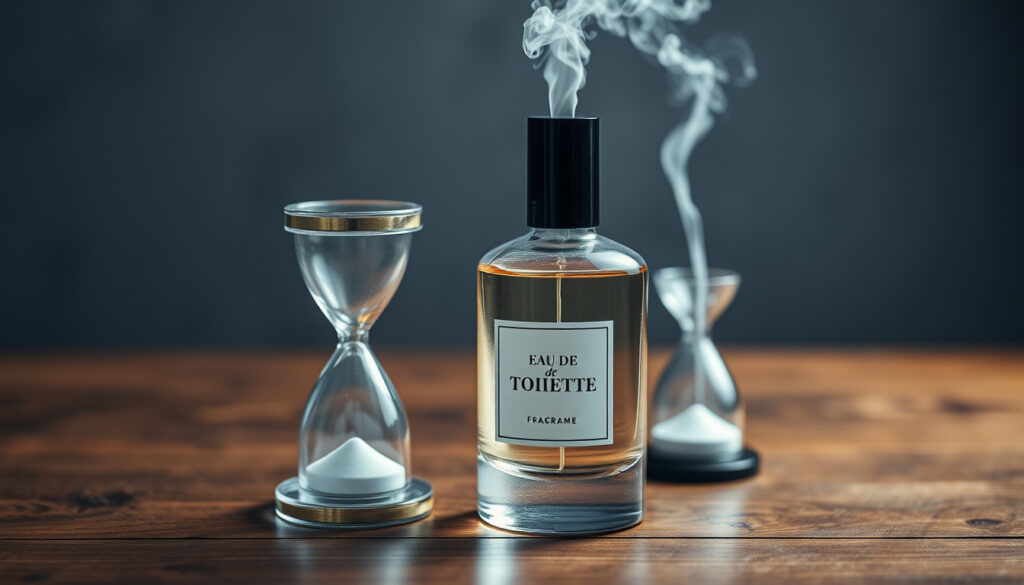
Eau de Toilette Meaning: Definition, Differences, and Longevity
Anyone who’s ever stood in a fragrance aisle, comparing labels and prices, has likely wondered what “eau de toilette” actually means. The phrase itself sounds elegant, but its history is far more practical than romantic.
Eau de toilette oil concentration: 5–15% fragrance oil ·
Eau de parfum oil concentration: 15–20% fragrance oil ·
Perfume extract oil concentration: 20–30% fragrance oil ·
Typical lasting time for eau de toilette: 2–4 hours on skin ·
Alcohol content in eau de toilette: 80–90%
Quick snapshot
- Lightly scented perfume with 5–15% oil (Everfumed)
- French for “grooming water” (Wikipedia)
- Ideal for daily wear (The Fragrance World)
- 2–4 hours on skin (The Fragrance World)
- Up to 6–8 hours on clothing (Piver)
- Depends on skin type and environment (Piver)
- EDT for casual, warm weather (The Fragrance World)
- EDP for evening or cooler weather (Nomad Wax)
- Parfum for special occasions (Everfumed)
Five fragrance concentrations show a clear pattern: the higher the oil percentage, the longer the scent stays and the more it costs.
| Label | Fragrance Oil Concentration | Typical Duration on Skin | Common Usage |
|---|---|---|---|
| Eau Fraîche / Body Mist | 1–3% | Under 1 hour | Light refreshment |
| Eau de Cologne (EDC) | 2–5% | 1–2 hours | Classic aftershave |
| Eau de Toilette (EDT) | 5–15% | 2–4 hours | Daily wear |
| Eau de Parfum (EDP) | 15–20% | 4–6 hours | Evening wear |
| Parfum / Extrait | 20–30% | 6–8+ hours | Special occasions |
The implication: the difference between EDT and EDP isn’t just marketing — it’s a measured chemical gap that directly changes how a fragrance behaves on your skin.
Eau de toilette is the most popular fragrance concentration in the world, yet it carries the lowest concentration of actual perfume oil among the major categories. That lightness is exactly why it works for daily wear — but it also means you’ll reapply more often.
What Does Eau de Toilette Mean?
Literal translation and origin of the term
- The French phrase “eau de toilette” literally translates to “toilet water” in English, but the meaning is not about plumbing. “Toilette” derives from the French verb “faire sa toilette,” which means “to get ready” or “to groom oneself.”
- According to the Merriam-Webster dictionary, eau de toilette is defined as a “perfumed liquid with a lower concentration of perfume oils than eau de parfum.”
- As Wikipedia notes, the term “toilet water” originally referred to scented water used as part of one’s grooming routine, not a bathroom product.
Historically, eau de toilette was a lightly scented body water used after washing or shaving. The Perfumer’s Apprentice explains that such fragrances were sold in large bottles meant for splashing on the body — a daily refreshment, not a concentrated statement.
What this means: the name is a linguistic fossil from 18th-century French grooming habits. It has nothing to do with toilets as we know them.
Eau de toilette in the context of fragrance concentrations
- In the fragrance industry, EDT is defined by its oil concentration: 5–15% aroma compounds in alcohol and water, as stated by Oudh Shop.
- This places it in the middle of the concentration spectrum — lighter than EDP and Parfum, but stronger than Cologne and Eau Fraîche.
- Some brands narrow the EDT range to 8–15% or 5–12%, notes Embark Perfumes, showing that exact numbers vary.
The pattern: there is no single universal standard for these percentages. The Merriam-Webster definition and the Wikipedia article both place EDT at 5–15%, but individual brands can deviate. The key takeaway is that EDT sits clearly below EDP in strength.
Fragrance concentration percentages are not legally required to be printed on the bottle in many markets, according to The Fragrance World. That means you could buy an EDT from one brand and a Cologne from another with the same oil percentage and never know.
Is Eau de Toilette for a Toilet?
Why the name causes confusion
- The literal English translation “toilet water” leads many to assume EDT is a cleaning product or air freshener, not a personal fragrance.
- This misconception is widespread online, with Blossom Perfumery devoting an entire post to debunking the “toilet water” myth.
- The confusion persists because the English word “toilet” has narrowed in meaning to a bathroom fixture, while the French “toilette” retains its original sense of grooming.
Historical use as a grooming aid, not a bathroom product. Eau de toilette was historically a refreshing body water used as part of one’s dressing routine. According to Piver, it was commonly applied after bathing or shaving to lightly scent the skin. The bottles were designed for generous application, often with wide necks for splash-on use.
Why this matters: if you avoid EDT because of its name, you’re missing out on a century-old grooming tradition. The “toilet water” label is a translation artifact, not a product description.
Eau de toilette is no more a toilet product than “toiletries” are. The shared root word simply means “grooming.” The bathroom association is entirely an English-language accident.
The takeaway: don’t let the name fool you — EDT is a legitimate personal fragrance.
What Is the Difference Between Perfume and Eau de Toilette?
Oil concentration comparison
- “Perfume,” in the strictest sense, refers to Parfum (Extrait) with 20–30% oil concentration, as outlined by Everfumed.
- EDT sits at 5–15%, meaning Parfum has roughly 2–3 times the concentration of fragrance oils.
- EDP (15–20%) falls between them, making it the most direct competitor to EDT in terms of everyday usability.
Longevity and sillage differences
- EDT typically lasts 2–4 hours on skin, according to The Fragrance World, while EDP lasts 4–6 hours or more.
- Parfum can last 6–8+ hours and projects less aggressively than EDP despite being stronger, because the alcohol content is lower and the oil evaporates more slowly.
- EDT projects brightly at first — a “sparkling” opening — then softens quickly, as Everfumed describes. EDP stays denser and richer throughout.
When to choose each
- EDT is the go-to for daytime, warm weather, office, and gym — situations where a lighter, less assertive scent is appropriate (The Fragrance World).
- EDP is better suited for evening events, cooler weather, and intimate settings where you want a scent that lasts without reapplying (Nomad Wax).
- Parfum is reserved for special occasions, date nights, or when you want maximum longevity with minimal spraying.
The trade-off: EDT requires reapplication but offers more versatility across settings. EDP gives staying power at the cost of weight and a higher price tag.
EDT lovers get to change scents throughout the day — a morning freshie, a lunchtime spritz, an evening boomer. EDP wearers lock in one scent for 6 hours. Your preference says as much about your lifestyle as your nose.
The verdict: neither is universally better; it depends on your daily routine and how often you want to reapply.
How Long Does Eau de Toilette Last?
Average duration on skin vs. clothing
- On skin, EDT typically lasts 2–4 hours, with some sources narrowing it to 2–3 hours (Nomad Wax) and others placing it at 3–5 hours (The Fragrance World).
- On clothing, EDT can last 6–8 hours because fabric absorbs the oils and releases them slowly over time.
- EDP, by comparison, often reaches 4–6 hours on skin and can last all day on clothes (Scento).
Factors that affect longevity (skin type, environment, application method)
- Skin type: oily skin holds fragrance longer than dry skin, as Piver explains.
- Environment: heat and humidity amplify projection but also speed up evaporation. Cold weather preserves the scent longer on skin.
- Application method: Layering EDT over an unscented moisturizer or applying to pulse points (wrists, neck, behind ears) extends wear. Spraying on clothing adds hours.
The catch: even within EDT, longevity varies enormously. Oudh Shop warns that some EDTs only last 2–3 hours on certain skin types, while others on moisturized or oily skin may push to 5. Skin chemistry is the wildcard.
What Are the Levels of Perfume?
The main concentration categories: Parfum, Eau de Parfum, Eau de Toilette, Eau de Cologne
- Four levels are most commonly recognized: Parfum (20–30%), EDP (15–20%), EDT (5–15%), and EDC (2–5%) (Everfumed).
- Some schemes count five by adding Eau Fraîche (1–3%) at the bottom, and some count only three by merging EDC and EDT or leaving out one category.
- The number of levels is not standardized, says Embark Perfumes. Each brand chooses its own nomenclature.
Why some sources list 3 levels and others 4
- Many consumer-facing guides treat “perfume” as an umbrella term and discuss three tiers: Eau de Toilette, Eau de Parfum, and Parfum/Extrait — skipping Cologne.
- In North America, fine fragrances sell best at EDT and EDP strengths, according to The Perfumer’s Apprentice, so Cologne and Eau Fraîche are often treated as separate product categories rather than levels.
- In contrast, the Wikipedia article lists four concentrations with overlapping ranges (EDT 5–15%, EDP 10–20%, Parfum 20–30%), acknowledging the fuzzy boundaries.
The pattern: whether you call it three or four levels, the core takeaway is the same — higher oil percentage means stronger, longer, pricier. The exact labels matter less than where the product sits on that sliding scale.
Upsides & Downsides of Eau de Toilette
Upsides
- Lighter, less overwhelming — perfect for offices, warm weather, and daytime
- More affordable than EDP and Parfum for the same brand and bottle size
- Wider variety of scents available, since EDT is the most common concentration in mass-market fragrances
- Easy to reapply throughout the day without becoming cloying
- Less alcohol sting on sensitive skin compared to higher-concentration formulas
Downsides
- Shorter lasting power — 2–4 hours on skin requires midday reapplication
- Weaker sillage (projection): around you, EDT stays close to the skin
- Not ideal for evening events or cooler weather where stronger scents perform better
- Price per hour of wear is higher if you buy smaller bottles and replace often
- Some fragrances lose their middle and base notes faster with EDT format, leaving only top notes
The verdict: EDT wins for versatility and cost per bottle. EDP wins for longevity and presence per spray. Your decision hinges on how often you want to reapply and how strong you want your scent to be.
“Eau de toilette is a perfumed liquid with a lower concentration of perfume oils than eau de parfum, used as a light body fragrance.”
— Merriam-Webster dictionary
“The term eau de toilette derives from the French phrase ‘faire sa toilette,’ meaning the act of washing and dressing oneself.”
— Wikipedia
“Despite the literal translation ‘toilet water,’ eau de toilette is not a bathroom cleaner. It’s a scented grooming water used for centuries as part of a daily freshening-up routine.”
— Blossom Perfumery
For the everyday fragrance buyer, the choice between EDT and EDP is clear: if you want a light, reapply-as-you-go scent for work and warm days, EDT is your match. If you want one spray that will carry you from dinner to midnight, go EDP. The eau de toilette meaning, once you strip away the confusing name and marketing jargon, is simply “a gentle way to smell good all day without shouting.” For anyone shopping their next bottle, the smartest step is to test the same fragrance in both EDT and EDP — your skin will tell you which one works.
essentia-perfume.com, scento.com, twistedlily.com, nomadwax.com, azizun.com, id.loccitane.com
Frequently asked questions
What is the difference between eau de toilette and cologne?
Eau de Cologne (EDC) has 2–5% fragrance oil and lasts 1–2 hours. Eau de Toilette (EDT) has 5–15% oil and lasts 2–4 hours. EDT is noticeably stronger and longer-lasting than classic cologne.
Can eau de toilette be used as a perfume?
Yes. EDT is a type of perfume. The word “perfume” is often used as an umbrella term for any scented liquid. In fact, EDT is the most common perfume concentration sold worldwide.
Does eau de toilette contain alcohol?
Yes, EDT typically contains 80–90% alcohol, which helps the fragrance evaporate and project. The high alcohol content is why EDT feels lighter and dries faster than higher-concentration formulations.
What does EDT stand for?
EDT stands for Eau de Toilette. It is a common abbreviation used on perfume bottles to indicate the concentration level. Similarly, EDP stands for Eau de Parfum.
How to apply eau de toilette for longer lasting?
To extend EDT’s wear time, apply it to pulse points (wrists, neck, behind ears) after moisturizing with an unscented lotion. Spraying on clothing can also add hours. Avoid rubbing the fragrance into your skin, as that breaks down the top notes.
Is eau de toilette stronger than eau de parfum?
No, EDT is weaker than EDP. EDT has 5–15% fragrance oil, while EDP has 15–20%. EDT lasts about 2–4 hours on skin, whereas EDP lasts 4–6 hours or more. EDP is the stronger and longer-lasting option.
More related posts
 Agriculture Tools in Bhuj: Best Dealers & Contacts
 Pilot of Air India Flight 171: Sumeet Sabharwal & Clive Kunder
 Race of Champions 2025: Results, Format, and How to Watch
 Toa Samoa vs Kiwis 2025 Tickets: Release Date, Price
 Crispy Pork Belly Recipe: Oven, Air Fryer, and More
 Westpac Branch Near Me: Find Location, Hours & ATMs
 Salomon XT-6 GORE-TEX: Full Guide & Where to Buy in Ireland
 What to Do in Perth: Top Attractions, Itineraries & Tips (2026)