Truck Driver Jobs Auckland: Requirements & Salary Guide
If you’ve been scrolling through job boards wondering whether there’s a realistic path into truck driving without years of experience, Auckland’s current market has a surprising answer: over 400 live truck driver listings on Seek alone, and the city’s freight and infrastructure sectors are actively recruiting across every license class — including entry-level. This guide breaks down what employers actually ask for, which license class unlocks the most opportunities, and where beginners can get a start.
Truck driver job listings on Seek Auckland: 422 ·
Truck driver job listings on Indeed Auckland: 26 ·
Truck driver job listings on LinkedIn Auckland: 29 ·
Most common license class requested: Class 5 ·
Average annual salary range: $60,000–$80,000
Quick snapshot
- Over 400 truck driver job listings exist on Seek in Auckland (Seek New Zealand (job aggregator))
- Class 5 is the most requested license class across listings (Indeed New Zealand (job aggregator))
- To get a full Class 5 licence, you must hold a full Class 4 licence first (NZ Transport Agency Waka Kotahi (government regulator))
- Exact salary offers depend on employer and experience level (Trade Me Jobs (classified marketplace))
- Number of entry-level positions varies seasonally (Indeed New Zealand (job aggregator))
- Future demand for truck drivers in Auckland is not officially forecasted (Trade Me Jobs (classified marketplace))
- Class 5 learner licence requires holding a full Class 4 licence for at least 6 months (Driving Tests NZ (licensing guide))
- From learner to full Class 5 typically takes several months of training and testing (Driving Tests NZ (licensing guide))
- Check job boards for immediate-start Class 2 and Class 5 roles (Haryana Driving Academy Auckland (training provider))
- Book a medical certificate appointment and start Class 1-2 training (Haryana Driving Academy Auckland (training provider))
| Platform | Active listings (Auckland) | Top license class |
|---|---|---|
| Seek | 422 | Class 5 |
| Indeed | 26 | Class 5 |
| 29 | Class 5 | |
| Trade Me Jobs | ~20–40 | Class 5 |
Four major platforms, one pattern: Class 5 dominates the Auckland truck driver market. Seek holds the largest inventory by far, making it the default starting point for any serious job search.
What are the requirements for Class 5 truck driver jobs in Auckland?
License endorsements needed for Class 5
- To get a full Class 5 licence in New Zealand, you must hold a full Class 4 licence first (NZ Transport Agency Waka Kotahi (government regulator)).
- A Class 5 learner licence requires holding a full Class 4 licence for at least 6 months (Driving Tests NZ (licensing guide)).
- Passing theory and practical tests is mandatory for each licence upgrade (TR Driver Training (Auckland-based provider)).
- Endorsements such as dangerous goods (D endorsement) may be required for specific freight types.
“To get a full Class 5 licence in New Zealand, you must hold a full Class 4 licence first.” – NZ Transport Agency Waka Kotahi (government regulator)
Medical fitness standards
- A medical certificate (NZ Transport Agency form) is mandatory for heavy vehicle licensing (NZ Transport Agency Waka Kotahi (government regulator)).
- Vision and general health checks are required, and must be completed by an approved doctor.
Experience prerequisites
- Many employers ask for 1–2 years of Class 4 or 5 experience, but some listings explicitly accept applicants with no prior truck-driving experience (Indeed New Zealand (job aggregator)).
- Class 1 and 2 roles often accept no experience, making them the realistic entry point (Unite Recruit (recruitment agency)).
Auckland’s Class 5 market is open, but the six-month Class 4 holding period is a fixed gate. No shortcut around it — plan your upgrade timeline early.
Can you get truck driver jobs in Auckland with no experience?
Entry-level truck driver roles
- Job boards show live listings for “no experience” truck driver roles in Auckland (Indeed New Zealand (job aggregator)).
- Class 1 and 2 roles are the most common entry points, with some employers offering trainee positions (Unite Recruit (recruitment agency)).
“Some listings explicitly accept applicants with no prior truck-driving experience.” – Indeed New Zealand (job aggregator)
On-the-job training programs
- Some Auckland companies provide on-the-job training for the right candidate, covering vehicle handling and site-specific procedures.
- Licensing costs (training and test fees) can be a barrier for beginners — some employers reimburse after probation.
Companies that hire beginners
- Logistics firms, waste management companies, and local delivery operators frequently advertise Class 2 roles that specify “no experience required.”
- Part-time and casual roles offer a lower-barrier entry compared to full-time permanent positions (Indeed New Zealand (job aggregator)).
For someone with a car licence (Class 1), getting into a Class 2 role is feasible within weeks. The real constraint isn’t experience — it’s the upfront investment in training and the medical certificate.
What heavy truck driver jobs are available in Auckland?
Heavy truck types: Class 4 vs Class 5
- Class 4: rigid heavy vehicles with 3+ axles, no trailer — used for large trucks in construction and waste services.
- Class 5: combination vehicles (truck and trailer) — used for freight, tanker, and tipper work across the region (NZ Transport Agency Waka Kotahi (government regulator)).
Typical heavy truck routes and industries
- Construction (tipper trucks, cement mixers) and freight (container, palletised goods) are the dominant sectors (Unite Recruit (recruitment agency)).
- Routes include Auckland metro delivery, regional runs to Waikato, and port-related work.
Salary expectations for heavy truck drivers
- Entry-level truck drivers in New Zealand typically earn NZ$45,000–$50,000 annually (GGIMS (career guide)).
- Class 5 heavy combination drivers make about NZ$75,000–$85,000 per year (GGIMS (career guide)).
- Trade Me listings show Class 5 roles advertised at NZ$30–$40 per hour (Trade Me Jobs (classified marketplace)).
The following table breaks down expected earnings by license class:
| License class | Typical annual salary (NZD) | Common vehicle types | Experience level |
|---|---|---|---|
| Class 1 | $40,000–$50,000 | Light vehicles, vans | Entry |
| Class 2 | $50,000–$65,000 | Rigid trucks (delivery, waste) | Entry to intermediate |
| Class 4 | $60,000–$75,000 | Large rigid trucks (construction) | Intermediate |
| Class 5 | $75,000–$85,000+ | Combination vehicles (freight, tanker) | Experienced |
Four tiers, one pattern: each class upgrade adds roughly NZ$10,000–$15,000 to the annual earning range. Class 5 isn’t just about bigger vehicles — it’s about significantly better pay.
Are there part-time truck driver jobs in Auckland?
Part-time hours and flexibility
- Part-time roles exist, especially in local delivery and courier services (Indeed New Zealand (job aggregator)).
- Class 2 and 3 roles are more common part-time than Class 4 or 5.
Where to find part-time truck driving listings
- Seek and Indeed both allow part-time filter searches — Seek lists several part-time Class 2 roles in Auckland.
- Weekend and night shifts are available, particularly in freight handling and supermarket supply chains.
Trade-offs for part-time employment
- Part-time roles often offer lower hourly rates than full-time equivalents due to less negotiating leverage.
- Benefits (health insurance, paid leave) are less common in part-time positions.
The implication: part-time roles offer flexibility but come with lower pay and fewer benefits, making them a stepping stone rather than a long-term career path.
What is the difference between Class 2, Class 4, and Class 5 truck driver jobs?
Vehicle type and weight limits
- Class 2: rigid heavy vehicles up to 18 tonnes maximum (NZ Transport Agency Waka Kotahi (government regulator)).
- Class 4: rigid heavy vehicles with 3+ axles, no trailer — larger than Class 2 but no combination coupling.
- Class 5: combination vehicles (truck and trailer) — allows the heaviest loads and most configuration options.
License upgrade path
- Obtain a Class 1 (car) licence – the starting point for all drivers.
- Upgrade to Class 2 – pass theory and practical tests for rigid heavy vehicles up to 18 tonnes.
- Hold Class 2 for at least 6 months (or the required period for Class 4) before moving to Class 4.
- Obtain Class 4 licence – allows operation of rigid vehicles with 3+ axles.
- Hold full Class 4 for at least 6 months, then apply for Class 5 learner licence; complete training and practical test for the full combination license.
- From Class 1 (car) → Class 2 → Class 4 → Class 5 (sequential). You cannot skip a class (NZ Transport Agency Waka Kotahi (government regulator)).
- Each step requires a learner licence, a theory test, a practical test, and a medical certificate.
Job availability by class
- Class 2: most common for entry-level roles, waste management, and local delivery. Plentiful opportunities.
- Class 4: fewer listings than Class 2 or 5, but steady demand in construction and bulk haulage.
- Class 5: highest number of listings in Auckland, best pay, and most diverse work types (Indeed New Zealand (job aggregator)).
Upsides of Class 2
- Fastest entry – can start within weeks with a car licence.
- Lower training costs – cheaper than Class 4 or 5.
- Plentiful entry-level roles.
Downsides of Class 2
- Lower pay ceiling – tops out around $65k.
- Limited to smaller trucks and local routes.
- Fewer opportunities for long-haul or specialised freight.
Upsides of Class 5
- Highest pay – $75k-$85k+.
- Widest job variety – freight, tanker, tipper, long-haul.
- Most listings on job boards.
Downsides of Class 5
- Multi-month licensing journey – at least 6 months of holding Class 4.
- Higher upfront cost for training and tests.
- Often requires 1–2 years experience for advertised roles.
Class 2 offers faster entry and lower training costs. Class 5 offers higher pay and more listings — but requires a multi-month, multi-step licensing journey. Choose based on your timeline, not just the wage.
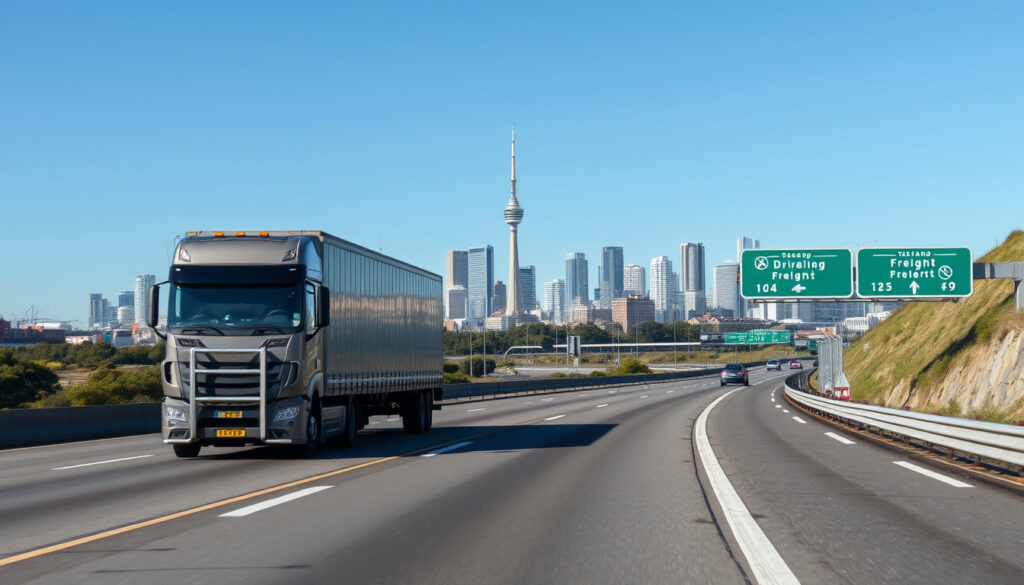
A comprehensive guide to truck driver jobs Auckland outlines the requirements and salary expectations for Auckland truck drivers.
Frequently asked questions
Do I need a dangerous goods endorsement for truck driving in Auckland?
Not always, but if you’re handling fuel, chemicals, or compressed gases, a D endorsement is required. Many Class 5 listings in freight and tanker work ask for it. You can obtain it after getting your Class 2+ license.
What medical tests are required for a truck driver license?
A standard medical certificate (NZ Transport Agency form) checks vision, blood pressure, hearing, and general health. It must be completed by an approved doctor and is valid for up to 5 years depending on age and medical history.
Are truck driver jobs in Auckland unionized?
Some large freight and logistics companies have union presence (e.g., FIRST Union). Union membership is not mandatory but can provide bargaining support and legal advice. Smaller operators typically don’t have union coverage.
Can I drive a truck in Auckland with a foreign license?
Yes, for up to 12 months if your license is in English or you carry an approved translation. After 12 months, you must convert to a New Zealand license by passing theory and practical tests for the relevant class.
How long does it take to upgrade from Class 1 to Class 5?
Realistically, 6 to 12 months. The minimum is 6 months holding Class 4 before applying for a Class 5 learner license. Adding training, test scheduling, and practice, most drivers take 8–12 months for the full progression.
What are the typical working hours for a truck driver?
Standard hours range from 40 to 60 per week, depending on routes and freight schedules. Night shifts and weekend work are common in freight and supermarket supply chains. Part-time roles typically offer 20–30 hours weekly.
Do truck drivers need to pass a drug test?
Many employers require pre-employment and random drug testing, especially in construction and hazardous materials transport. Testing policies are common for Class 5 roles. Refusal can result in disqualification.
Is there a demand for female truck drivers in Auckland?
Yes, several companies actively encourage women to apply. Initiatives like the Women in Trucking programme provide support and training. The market is still male-dominated but openness to diverse applicants is growing.
Auckland’s truck driver market is in a distinct phase: live listings are abundant, Class 5 dominates the boards, and entry-level pathways exist for those willing to invest in training. The infrastructure boom and supply chain needs aren’t slowing down. For someone holding a car license in Auckland, the choice is straightforward: start with Class 2, get the medical certificate, and build upward — or stay on the sidelines while the freight keeps moving.
More related posts
 ANZ App Not Working? Quick Fixes & Status Check
 Where to Find Cheap Textbooks: Top Comparison Sites
 Manila to Auckland Flight: Duration, Prices & Tips
 Ranfurly Shield Game Today: Current Holder, Score & How to Watch
 Cast of Beyond Paradise: Guest Stars, Departures, Locations
 Anton Lienert-Brown Contract, Injury, and All Blacks Future
 NZ Take Home Pay Calculator 2026 – Step-by-Step Guide
 Geraldine Rugby Club Inc – History Teams Membership Guide