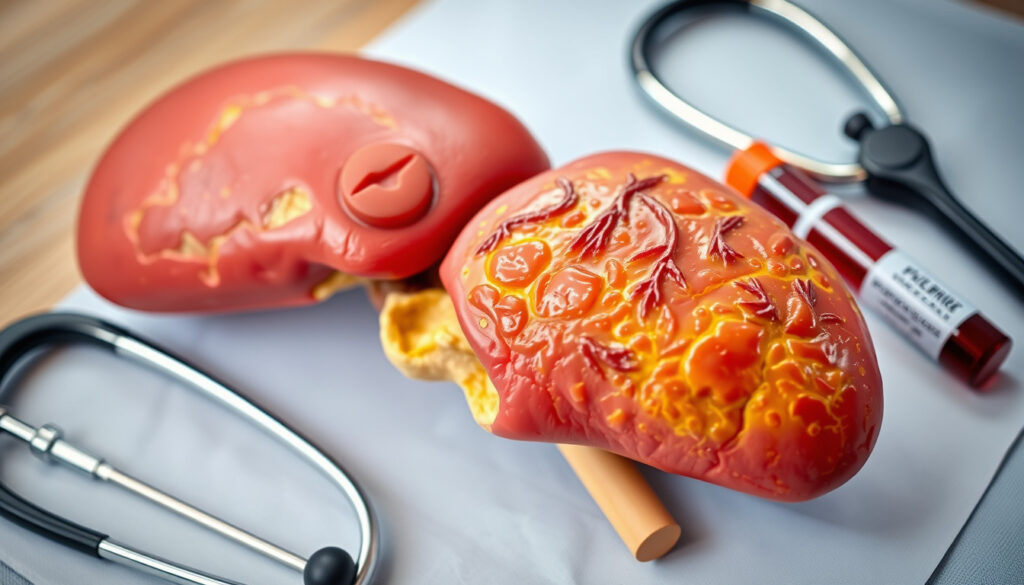
Signs of Liver Disease: Early Symptoms & Warning Signs
You might not think much about your liver until something feels off — a lingering tiredness, a dull ache on your right side, or a strange change in the bathroom. Yet the liver is remarkably quiet until it’s under serious strain.
U.S. adults with liver disease: 4.5 million (CDC) ·
Annual global deaths from liver disease: 2 million (WHO) ·
Liver cancer mortality: 830,000 deaths/year (WHO) ·
Percentage of liver disease cases linked to alcohol: ~50% (NIH)
Quick snapshot
- Jaundice (yellow skin/eyes) is a definitive sign of liver dysfunction (Johns Hopkins Medicine)
- Ascites (abdominal swelling) indicates advanced liver disease or cirrhosis (Johns Hopkins Medicine)
- Dark urine with pale stools strongly suggests obstructive jaundice (Mayo Clinic)
- Early symptoms like fatigue and nausea are non‑specific and may be caused by many conditions (Cleveland Clinic)
- Home self‑checks are not reliable for diagnosis beyond screening (Mayo Clinic)
- Early stage often asymptomatic; progression can include jaundice, ascites, and portal hypertension over months to years (Johns Hopkins Medicine)
- If you notice persistent fatigue, jaundice, or swelling, see a primary care doctor for blood tests (LFTs) (NHS)
- Early‑stage fatty liver disease can be reversed with lifestyle changes (Mayo Clinic)
Twelve key facts, one pattern: the liver’s distress signals range from vague early complaints to unmistakable red‑flag symptoms that demand immediate attention.
| Fact | Value |
|---|---|
| Global burden | 2 million deaths annually from liver disease (World Health Organization) |
| U.S. prevalence | 4.5 million adults diagnosed (U.S. Centers for Disease Control and Prevention) |
| Alcohol‑related | ~50% of liver disease cases linked to alcohol (National Institute on Alcohol Abuse and Alcoholism) |
| Reversibility | Early‑stage fatty liver disease can be reversed with lifestyle changes (Mayo Clinic) |
| Jaundice | Yellowing of skin and eyes due to high bilirubin (Johns Hopkins Medicine) |
| Ascites | Fluid buildup in the abdominal cavity (Johns Hopkins Medicine) |
| Dark urine | Cola‑colored urine often signals bilirubin (Mayo Clinic) |
| Pale stool | Light‑colored stool is a commonly listed symptom (Cleveland Clinic) |
| Itchy skin | Common symptom of liver disease (Mayo Clinic) |
| Easy bruising | Common symptom indicating clotting problems (Mayo Clinic) |
| Fatigue | Early, non‑specific symptom (Cleveland Clinic) |
| Appetite loss | One of the early signs, often accompanied by nausea (Liver Foundation Australia) |
What are the first signs of a bad liver?
Your liver doesn’t send pain signals the way a pulled muscle does. Instead, it whispers through fatigue, a drop in appetite, or a vague nausea that comes and goes. Ignoring these early whispers can let a reversible condition turn into something more serious.
What are early signs of liver problems?
- Fatigue and weakness — among the earliest symptoms, often dismissed as everyday tiredness (Cleveland Clinic)
- Loss of appetite and unexplained weight loss (Mayo Clinic)
- Nausea and vomiting (Cleveland Clinic)
- Pain or discomfort in the upper right abdomen (Mayo Clinic)
How do you know if you had liver disease?
- Blood tests (liver function tests) are the standard diagnostic tool (Mayo Clinic)
- Imaging like ultrasound can detect fatty liver, cirrhosis, or tumors (Johns Hopkins Medicine)
- Often the disease is discovered incidentally during a routine check‑up (NHS)
Early liver disease can be completely asymptomatic — absence of symptoms does not rule it out. That’s why millions of cases are diagnosed only after noticeable damage has occurred (Mayo Clinic).
The implication: vague complaints that persist beyond two weeks warrant a simple blood test — catching fatty liver early makes reversal possible.
What are the four warning signs of a dying liver?
When liver function collapses, the body’s compensatory mechanisms fail in predictable ways. These four signs represent the final alarm — they require urgent medical evaluation.
How can you tell if your liver is struggling?
- Jaundice (yellowing of skin and eyes) — caused by bilirubin buildup (Johns Hopkins Medicine)
- Ascites (abdominal swelling due to fluid buildup) — indicates portal hypertension (Johns Hopkins Medicine)
- Confusion or disorientation (hepatic encephalopathy) — toxins affect the brain (Johns Hopkins Medicine)
- Easy bruising and bleeding — clotting factor production drops (Mayo Clinic)
If someone with known liver disease becomes confused, vomits blood, or passes blood in stool, the Liver Foundation Australia advises immediate hospital care — these are signs of acute decompensation.
Why this matters: these four signs often appear together or in rapid succession. Their presence moves the conversation from “lifestyle change” to “urgent specialist referral.”
How to check liver health at home?
Home observation can catch early clues, but it’s never a substitute for lab work. The best home screen is a systematic look at three areas: skin, belly, and bathroom habits.
What are the visible signs of liver disease?
- Self‑exam for jaundice in the whites of the eyes and under the tongue (on darker skin, check the palms and soles) (Mayo Clinic)
- Observing urine color — dark brown or cola‑colored may indicate bilirubin (Mayo Clinic)
- Checking for ascites by measuring waist circumference — a sudden increase is suspicious (Johns Hopkins Medicine)
- Noting persistent fatigue and appetite changes (Cleveland Clinic)
When should you see a doctor?
- Any combination of jaundice, dark urine, pale stool, and abdominal swelling (Mayo Clinic)
- Unexplained bruising or bleeding gums/nose (British Liver Trust)
- Persistent nausea, vomiting, or weight loss alongside fatigue (NHS)
The trade‑off: home checks give you a head start, but only blood tests can quantify liver enzyme levels and confirm disease stage.
What does a liver belly look like?
Ascites, commonly called “liver belly,” is a distended abdomen filled with fluid. It’s not fat — the belly feels tight and heavy, and the skin may shine.
Ascites (swollen belly) — Liver Foundation
- Liver belly describes a distended abdomen due to ascites (Johns Hopkins Medicine)
- Skin may appear stretched and shiny (Mayo Clinic)
- Umbilicus (belly button) may protrude outward (Cleveland Clinic)
- Accompanied by weight gain despite muscle wasting in the arms and legs (Johns Hopkins Medicine)
The pattern: ascites plus jaundice and confusion is a near‑certain sign of decompensated cirrhosis — the stage where transplantation evaluation begins.
What color is pee when the liver is failing?
Urine color is one of the earliest bathroom clues. When the liver can’t clear bilirubin, the pigment spills into urine, turning it dark.
What does dark urine indicate?
- Dark brown or cola‑colored urine often signals increased bilirubin (Mayo Clinic)
- May be accompanied by pale stools (light clay color) (Cleveland Clinic)
- Not all dark urine is liver‑related — dehydration, certain medications, and beets can also cause discoloration (NHS)
- Consistently dark urine warrants medical evaluation, especially if combined with pale stools (Mayo Clinic)
The catch: dark urine is a cheap, early sensor — if it persists for more than a couple of days despite adequate fluid intake, ask your doctor for a bilirubin test.
How to check liver health at home — a step‑by‑step guide
Systematic self‑observation can help you decide when to seek lab work. Follow these steps monthly if you have risk factors (obesity, alcohol use, family history, type 2 diabetes).
- Check your eyes and skin for yellow tint in natural light. Look at the whites of your eyes and under your tongue. On darker skin, examine the palms, soles, and inner lips (Mayo Clinic).
- Inspect your urine color every morning for a week. If it’s consistently dark brown or cola‑colored (and you’re not dehydrated), note it (Mayo Clinic).
- Monitor stool color. Pale, clay‑colored, or greasy stools suggest low bile flow (Cleveland Clinic).
- Measure your waist at the belly‑button level weekly. An increase of 2–3 inches over a month with no change in diet is suspicious for ascites (Johns Hopkins Medicine).
- Notice your energy and appetite. Fatigue that doesn’t improve with rest, plus loss of appetite or nausea after meals, is a classic early signal (Liver Foundation Australia).
- Check for easy bruising. If you bruise without obvious injury or notice frequent nosebleeds/bleeding gums, flag it (Mayo Clinic).
- Record your findings and see a doctor if you have any persistent abnormality. Home tests including urine bilirubin strips exist but are not reliable — only lab LFTs give a definitive answer (Mayo Clinic).
A patient who catches early signs and reduces alcohol intake or addresses metabolic risk factors can halt or reverse fatty liver disease within three to six months (Mayo Clinic). The window is real, but it closes the moment cirrhosis sets in.
What’s confirmed, what’s still unclear
Medical consensus is strong on the red‑flag symptoms but acknowledges that early detection is complicated by vague, overlapping presentations.
Confirmed facts
- Jaundice is a definitive sign of liver dysfunction (Johns Hopkins Medicine)
- Ascites indicates advanced liver disease or cirrhosis (Johns Hopkins Medicine)
- Dark urine with pale stools strongly suggests obstructive jaundice (Mayo Clinic)
- Confusion (hepatic encephalopathy) is a medical emergency (Johns Hopkins Medicine)
What’s unclear
- Early symptoms like fatigue and nausea are non‑specific (Cleveland Clinic)
- Home self‑checks are not reliable for diagnosis beyond screening (Mayo Clinic)
- The exact timing of progression from early to advanced disease varies widely (Johns Hopkins Medicine)
Expert perspectives on liver disease signs
“Jaundice is a yellow discoloration of the skin and eyes caused by high bilirubin levels.”
— Mayo Clinic
“Regular nose bleeds or bleeding gums can be a sign of liver disease.”
“Feeling very tired and weak all the time is a common symptom of liver disease.”
— NHS
Summary
The liver’s early distress signals — fatigue, appetite loss, dark urine — are easy to dismiss, but they carry a concrete opportunity for reversal. For anyone with risk factors such as obesity, heavy alcohol use, or type 2 diabetes, the choice is clear: schedule a liver function test now, or wait until a swollen belly and yellow eyes force the conversation. The window for simple lifestyle intervention closes as cirrhosis develops, so the smartest move is to act on the subtle signs weeks before they become obvious.
premieregi.com, southerncalgi.com, kevinmarksmd.com, eroffortworthtx.com
Recognizing the early warning signs of liver disease, such as those detailed in early warning signs of liver disease, can help you take action before the condition progresses.
Frequently asked questions
Can liver disease be cured?
Some liver diseases can be reversed if caught early. Fatty liver disease (steatosis) is often reversible with weight loss, diet, and exercise. Cirrhosis, however, is usually permanent, though its progression can be slowed.
What causes liver disease?
Common causes include long‑term alcohol use, obesity, type 2 diabetes, hepatitis viruses (B, C), certain medications, and genetic disorders. Metabolic dysfunction‑associated steatotic liver disease (MASLD) is now the most common cause in developed countries (Mayo Clinic).
Is liver disease reversible?
Early‑stage fatty liver disease can be reversed with lifestyle changes — losing 5–10% of body weight significantly reduces liver fat. Once fibrosis or cirrhosis develops, the damage is largely permanent, but progression can be halted.
What are the stages of liver disease?
Stages include: 1) Steatosis (fatty liver, often reversible), 2) Steatohepatitis (inflammation), 3) Fibrosis (scarring), 4) Cirrhosis (advanced scarring), 5) End‑stage liver disease or liver cancer.
How is liver disease diagnosed?
Using blood tests (liver function tests, bilirubin, clotting factors), imaging (ultrasound, CT, MRI), and sometimes liver biopsy to assess fibrosis stage.
What are the risk factors for liver disease?
Major risk factors include heavy alcohol intake, obesity, type 2 diabetes, high cholesterol, hepatitis B or C infection, family history, and exposure to blood‑borne viruses through needles or tattoos.
Can you live with one damaged liver?
A damaged liver can still function if enough healthy tissue remains. In compensated cirrhosis, many people live for years with careful management. However, decompensated cirrhosis (ascites, jaundice, encephalopathy) often requires transplant evaluation.
More related posts
 Questions to Ask Someone: 200+ Conversation Starters
 Download Video From Youtube – Safe Legal Guide 2025
 Love It or List It 2026: Pay, Host Changes, and Status
 Pak n Save Henderson: Hours, Online Shopping, Specials & Locations
 Cast of Once Upon a Time in Hollywood: Actors & Roles
 Phoebe Waller-Bridge: Relationship & Fleabag Facts 2025
 What Is a Gene? Simple Definition and Function
 New Zealand Latest News – Today’s Breaking Stories and Updates