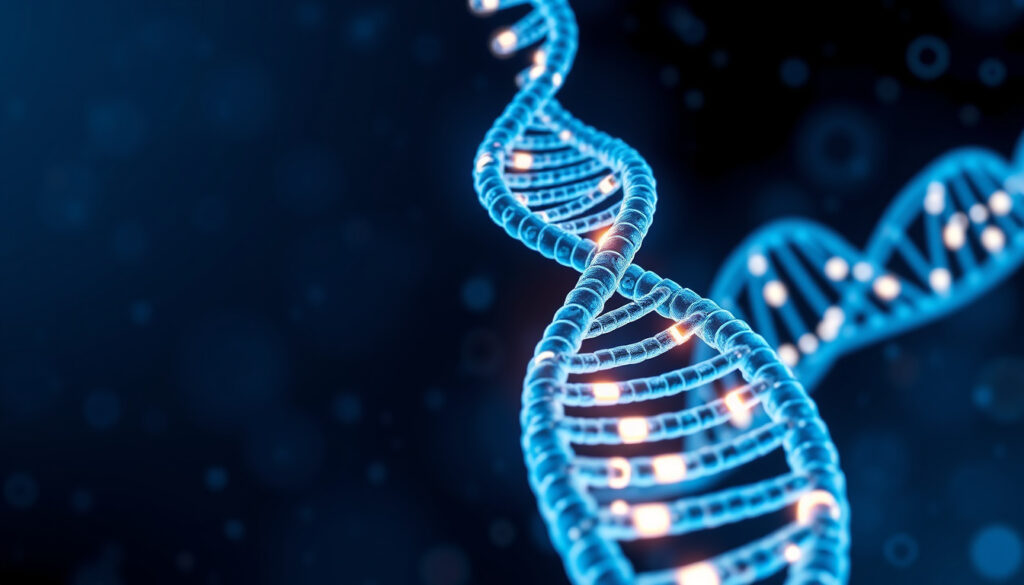
What Is a Gene? Simple Definition and Function
If you’ve ever wondered why you have your mother’s eyes or your father’s smile, you’ve already met a gene—even if you didn’t know it. Genes are the tiny instruction manuals inside every cell that determine everything from your hair color to how your body processes food.
Human protein‑coding genes: ~20,000 · Average gene length: ~10,000 base pairs · Human genome size: 3.2 billion base pairs
Quick snapshot
- Unit of heredity (Britannica)
- Made of DNA (Genome.gov)
- Contains instructions for proteins (CDC)
- 1,000–100,000 base pairs (Jackson Laboratory)
- Much smaller than the whole genome (Genome.gov)
- Human genome: 3.2 billion base pairs (Genome.gov)
- Codes for proteins or functional RNA (CDC)
- Determines traits (e.g., eye color) (Britannica)
- Can be turned on or off (MedlinePlus)
- DNA is the molecule (Genome.gov)
- Gene is a segment of DNA (Genome.gov)
- Allele is a variant of a gene (Genome.gov)
The table below distills the key metrics for human genes.
| Fact | Value |
|---|---|
| Number of human genes | ~20,000 protein‑coding |
| Average gene length | ~10,000 base pairs |
| Exons vs introns | Most human genes have introns (non‑coding) and exons (coding) |
| Percentage of genome coding | ~1–2% |
What is a simple definition of a gene?
A gene is the basic physical and functional unit of heredity, made of DNA and carrying the instructions your body uses to build proteins and functional RNA molecules. To see it in action, consider the OCA2 gene—it influences how much melanin your body produces, which in turn determines your eye color.
What is a gene made of?
- Genes are segments of DNA—a long, double‑stranded molecule that stores genetic information. According to the National Human Genome Research Institute (NIH official genetics glossary), genes are specific sections within the DNA molecule.
- Each gene contains a coding region (exons) interrupted by non‑coding stretches (introns). The CDC (public health agency) explains that genes give your cells instructions for making proteins.
What is a gene example?
- The OCA2 gene, located on chromosome 15, provides instructions for a protein involved in melanin production. Different versions (alleles) of OCA2 lead to brown, blue, or green eyes.
The implication: this definition frames the gene as a functional unit, but the full picture includes regulatory sequences and non‑coding elements.
Which best defines a gene?
Two complementary definitions exist: one functional, one structural. Neither is wrong, but each highlights a different aspect of what a gene is.
What is a gene in biology?
- Functional definition: A DNA sequence that codes for a final functional product (a protein or a non‑coding RNA). The National Center for Biotechnology Information (NIH‑affiliated resource) describes this as the “one gene–one polypeptide” concept.
- Structural definition: A segment of DNA that occupies a specific locus on a chromosome. The Britannica (established encyclopedia) notes that a gene resides at a fixed location on each chromosome.
What is a gene in genetics?
- In the genetic context, a gene is the unit of hereditary information passed from parent to offspring. The Genome.gov glossary (NIH official genetics glossary) defines it as “the basic physical and functional unit of heredity.”
The pattern: textbooks lean toward the functional definition when teaching molecular biology and toward the structural definition when teaching chromosome mapping. Both are valid, and both ultimately describe the same thing.
What is a gene vs DNA?
This is one of the most common points of confusion. The short answer: DNA is the molecule; a gene is one specific stretch within it. For a detailed comparison, see our Gene vs DNA vs Allele Comparison Guide.
What is a gene vs allele?
An allele is a variant form of the same gene. For example, the gene for eye color (OCA2) has brown‑eye and blue‑eye alleles. The Genome.gov glossary (NIH official genetics glossary) defines an allele as “one of two or more versions of DNA sequence at a given genomic location.” The CDC adds that alleles are alternative forms of the same gene with slight differences in their DNA sequence.
One comparison shows the hierarchy clearly:
Three related concepts, one hierarchy: DNA is the complete library, genes are the individual chapters, and alleles are the different editions of the same chapter.
| Feature | DNA | Gene | Allele |
|---|---|---|---|
| Definition | Molecule carrying genetic instructions | Specific segment of DNA that codes for a product | Version of a gene |
| Size | 3.2 billion base pairs (human genome) | ~1,000–100,000 base pairs | Same length as the gene, but may differ by one or more bases |
| Relationship | Contains all genes | Part of the DNA, located at a locus | Alternative form of that locus |
| Examples | Human genome, bacterial plasmid DNA | OCA2 (eye‑color gene) | Brown‑eye allele vs blue‑eye allele |
Which is bigger a gene or DNA?
- The entire DNA molecule (the genome) is vastly larger than a single gene. The human genome spans roughly 3.2 billion base pairs, while a typical human gene is about 10,000 base pairs long, as noted by the Jackson Laboratory (biomedical research institution).
- Only about 1–2% of DNA actually codes for proteins. The rest includes regulatory regions, introns, and other non‑coding sequences.
What is a gene in simple terms?
Imagine your body’s cells each contain a giant cookbook (the genome). A gene is a single recipe in that book—it tells the cell how to make one specific thing, usually a protein. Humans have about 20,000 such recipes. For a deeper dive, read What is a Gene? Understanding the Basics of Genetic Information.
What is a gene in humans?
- Humans have approximately 20,000 protein‑coding genes, according to the Human Genome Project. These genes determine traits like height, blood type, and susceptibility to certain diseases.
- Not all genes are active in every cell. The MedlinePlus Genetics (NIH consumer health resource) explains that genes can be turned on or off depending on the cell’s needs.
What is a gene a level biology?
- At the A‑level (advanced high‑school biology), a gene is defined as “a sequence of bases on DNA that codes for a single polypeptide chain.” This functional definition emphasizes the link between DNA sequence and protein synthesis.
For students, the gene‑as‑recipe analogy works perfectly until you meet introns, regulatory sequences, and overlapping reading frames. The simple definition is a starting point, not the full story.
What this means: the simple recipe analogy is useful for beginners, but advanced genetics requires a more nuanced view.
Which is bigger a gene or DNA?
We’ve already touched on this, but let’s be explicit: DNA is the whole landscape; a gene is a single house on that landscape.
- The human genome (all DNA) contains about 3.2 billion base pairs. A gene averages 10,000 base pairs. That means the genome is roughly 320,000 times larger than an average gene.
- Even the largest known human gene—the dystrophin gene at 2.4 million base pairs—is only a tiny fraction of the total genome.
The trade‑off: when people say “DNA test,” they typically look at small gene‑sized regions, not the whole genome. Knowing the scale explains why genetic testing focuses on specific markers rather than reading every letter.
Confirmed facts
- Genes are made of DNA.
- Genes code for proteins or functional RNAs.
- Humans have approximately 20,000 protein‑coding genes.
What’s unclear
- Exactly how many regulatory regions are considered part of a gene remains debated.
- The definition of a gene continues to evolve with discoveries of non‑coding RNA genes and overlapping reading frames.
- The precise number of non‑coding RNA genes in humans is still unknown.
“A gene is the basic physical and functional unit of heredity. Genes are made up of DNA.”
“Genes are segments of DNA that give your cells instructions for specific traits or body functions.”
“A gene is a string of DNA letters that encode a protein – the building blocks of our cells and bodies.”
For anyone trying to understand genetics for the first time, the takeaway is straightforward: genes are functional DNA segments that code for proteins, and alleles are the slightly different versions of those segments. The molecular hierarchy—DNA → gene → allele—is the foundation of modern biology. Students and curious readers alike can walk away with a clear mental map: the genome is the whole library, each gene is a chapter, and alleles are alternative editions of the same chapter.
genome.gov, nature.com, technologynetworks.com, idtdna.com, sciencedirect.com, nature.com, reddit.com, reddit.com
For a more detailed breakdown of how genes differ from DNA and alleles, see a clear definition of a gene.
Frequently asked questions
How do genes affect health?
Genes carry instructions for proteins that control everything from metabolism to immune response. Variations (mutations) can increase risk for certain diseases, but lifestyle and environment also play major roles.
Can genes be turned on and off?
Yes. Cells regulate gene activity through mechanisms like transcription factors, DNA methylation, and histone modifications. This allows a skin cell and a liver cell to use different sets of genes despite having identical DNA.
Do all organisms have the same number of genes?
No. Simple bacteria have a few thousand genes; humans have about 20,000; rice has more than 50,000. Gene count does not correlate with organism complexity.
How are genes inherited from parents?
Each child receives one copy of each gene from each parent. For most genes, the two copies (alleles) may be identical or different. If they differ, the dominant allele often determines the trait.
What is a mutation in a gene?
A mutation is a permanent change in the DNA sequence of a gene. It can be as small as a single base substitution or as large as a deletion of thousands of bases. Some mutations cause disease; many have no effect.
What is the difference between a gene and a chromosome?
A chromosome is a long, packaged structure of DNA that contains many genes. Humans have 46 chromosomes; each chromosome holds hundreds to thousands of genes arranged linearly.
More related posts
 Diana, Princess of Wales: Mysteries That Remain
 Galaxy Z Fold 4 to Buy: Price, Trade-In, Fold 5 Comparison
 Fisher & Paykel DishDrawer: Reset, Operate & Troubleshoot
 Questions to Ask Someone: 200+ Conversation Starters
 Wellington Phoenix vs Auckland FC Tickets: Prices & Buy Guide
 International Flight Arrivals Christchurch: Live Status, Terminal
 Cars for Sale NZ: Best Platforms & Price Guide for 2025
 400 AUD to NZD: Live Rate & Best Exchange Tips